
Asked what is behind the growth in Middletown↗ET's prekindergarten enrollment, the district's new superintendent answered by naming the grade where he believes the achievement gap opens.
"The national achievement (between all students and high-need students) gap does not start in high school - it starts in kindergarten," Joseph P. Macary wrote in response to questions from The CTEdTribune. "The difference between those with a pre-kindergarten experience and those without is directly correlated to the difference in student achievement."
Connecticut's own enrollment record shows the district already moving in that direction before he arrived. The district's published prekindergarten count was 123 students in 2014-15 and 237 in 2025-26, the most recent school year in the state's published data. That is a gain of 114 children, or 92.7%, roughly double. Statewide prekindergarten grew 12.5% across the same years.
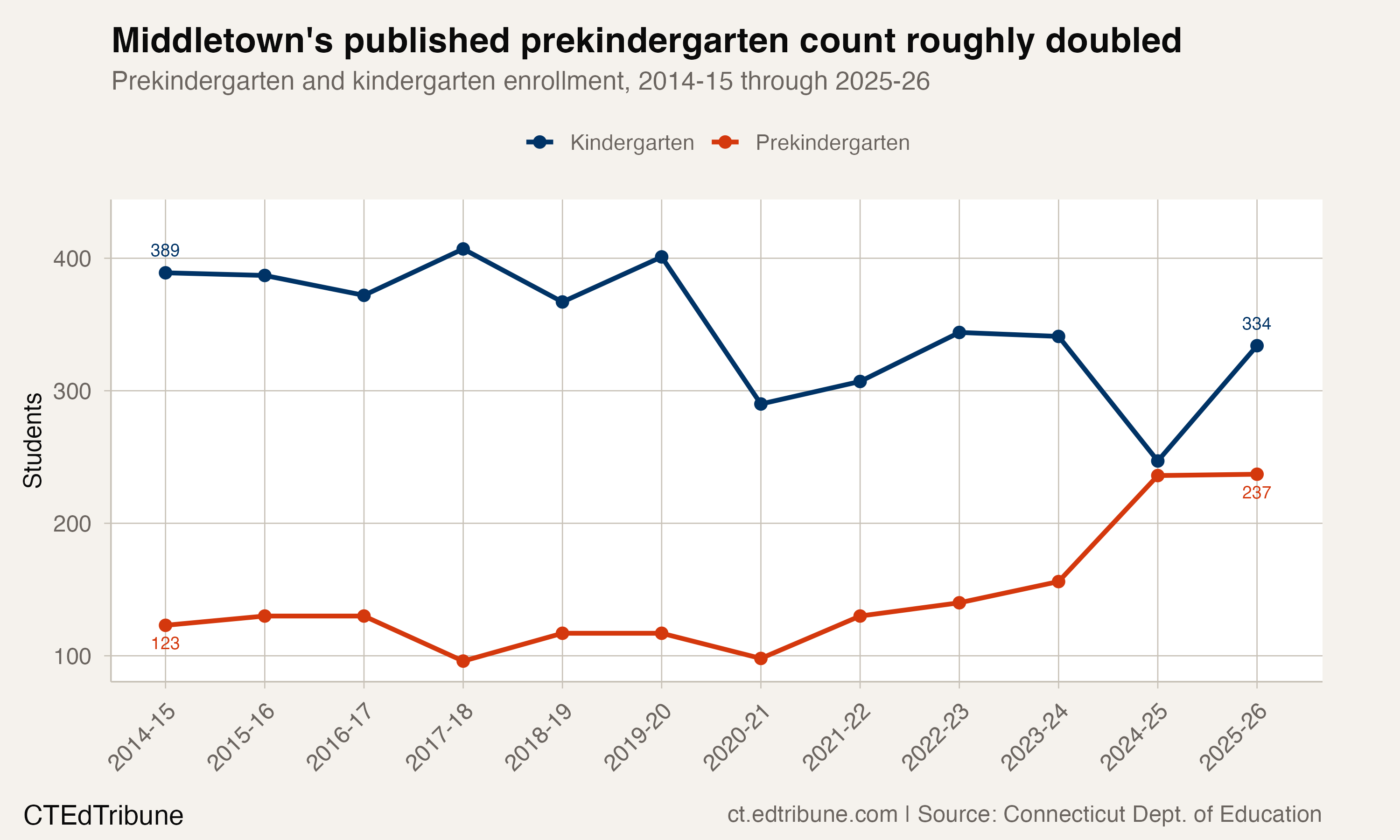
Most of that came recently. The largest single-year move in the published record added 80 prekindergarten students in 2024-25, and the count has held at that level since. The enrollment file records the size of the change and nothing about its cause. It cannot separate a program expansion from a shift in which publicly funded seats get reported to the state, and it does not say where the children came from.
Macary said he wants the whole age group in a seat. "Our goal is for Middletown to have all its early childhood students in a meaningful pre-kindergarten experience," he wrote. "This will minimize the achievement gap and give all students an equitable opportunity to succeed in school and life."
From Waterbury to Vernon to Middletown
Macary started in Middletown on July 6, 2026, a date he confirmed in writing. The board named him at its April 7 meeting and approved the appointment unanimously under board chair Sheila Daniels. He follows Alan Addley, who had been serving as Middletown's interim superintendent. The district's own superintendent page now lists him as Superintendent of Schools effective July 2026.
He came to Middletown from Vernon Public Schools, which he led from October 2015 to July 2026, and before that from six years as superintendent in Wolcott. His career started in a Waterbury classroom, teaching social studies at Wilby High School and then at Crosby High School, where he later became social studies department chair and athletic director. He graduated from Crosby himself. "I graduated from there and taught there," he wrote, calling it "a special place." He holds a bachelor's degree in political science from the University of Connecticut, a master's in teaching from Quinnipiac, a sixth-year degree in educational leadership from Southern Connecticut State University, and a 2016 doctorate in educational leadership from UConn. In 2024 the Connecticut Association of Public-School Superintendents named him Superintendent of the Year.
He described the move as a deliberate close of one chapter rather than an escape from it.
"I loved working in Vernon - we had created the 'secret sauce'," Macary wrote. Vernon, he wrote, "was an excellent system that went to the next level of educational excellence. Now it was time for another person to lead." What drew him to Middletown was the kind of district it is: "Having been from Waterbury, I wanted to lead another urban area/Alliance district, like Vernon. The Middletown position was posted and I was interested in another personal challenge to make a difference in the lives of children, like myself."
Middletown is the larger of the two. Its published total was 4,344 students in 2025-26 against Vernon's 3,246.
Where the enrollment loss happened
The enrollment landscape Macary inherited has two halves, and only one of them is a good story.
Across the published record, Middletown has lost ground faster than Connecticut has. The district enrolled 4,794 students in 2014-15 and 4,344 in 2025-26, a fall of 450 students, or 9.4%. Connecticut's published statewide total fell 8.9% over the same years.
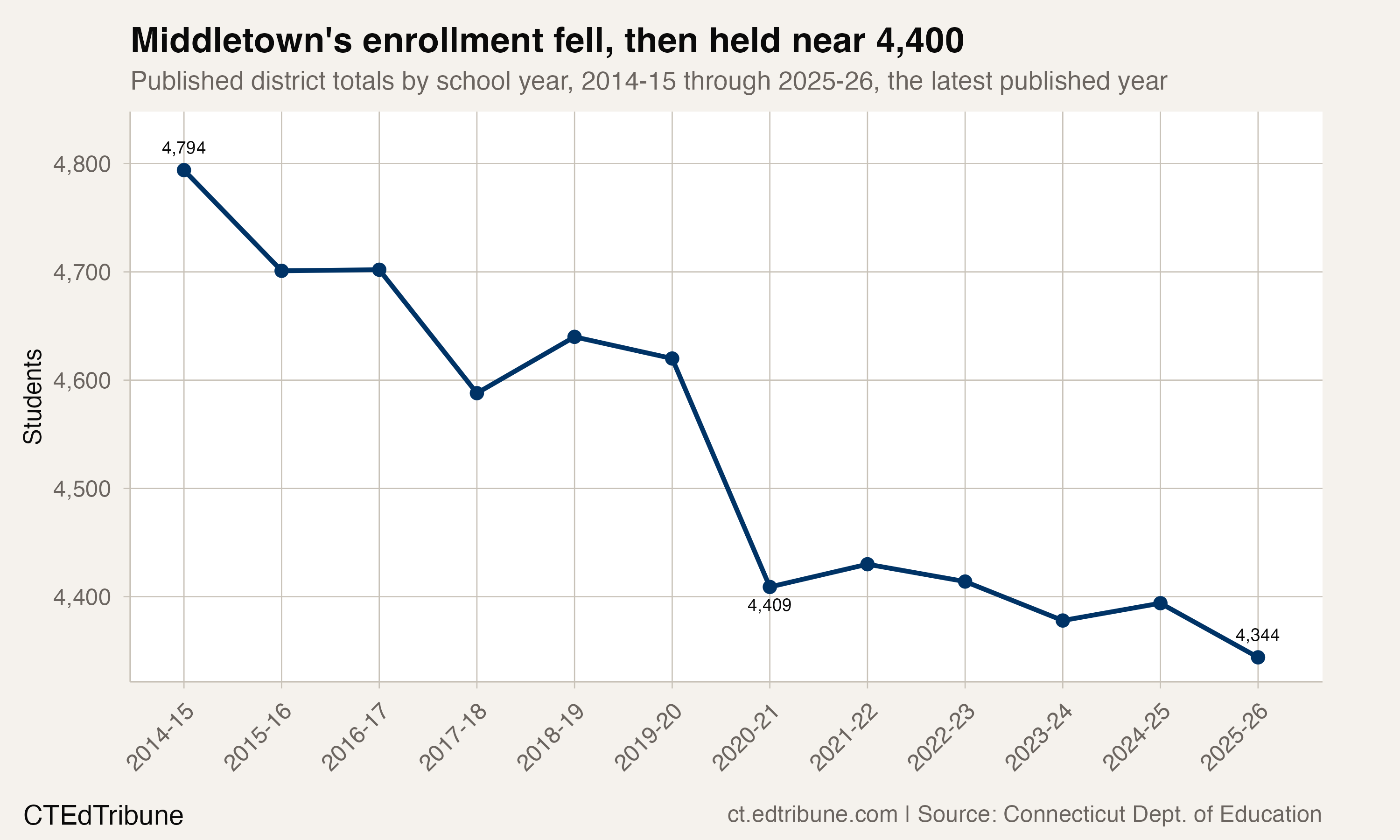
Nearly all of the district's loss happened in the first half of that window. Middletown was down 8.0% by 2020-21 while the state was down 6.1%. Since 2020-21 the district has moved 65 students, a fall of 1.5%, while Connecticut fell 3.0%.
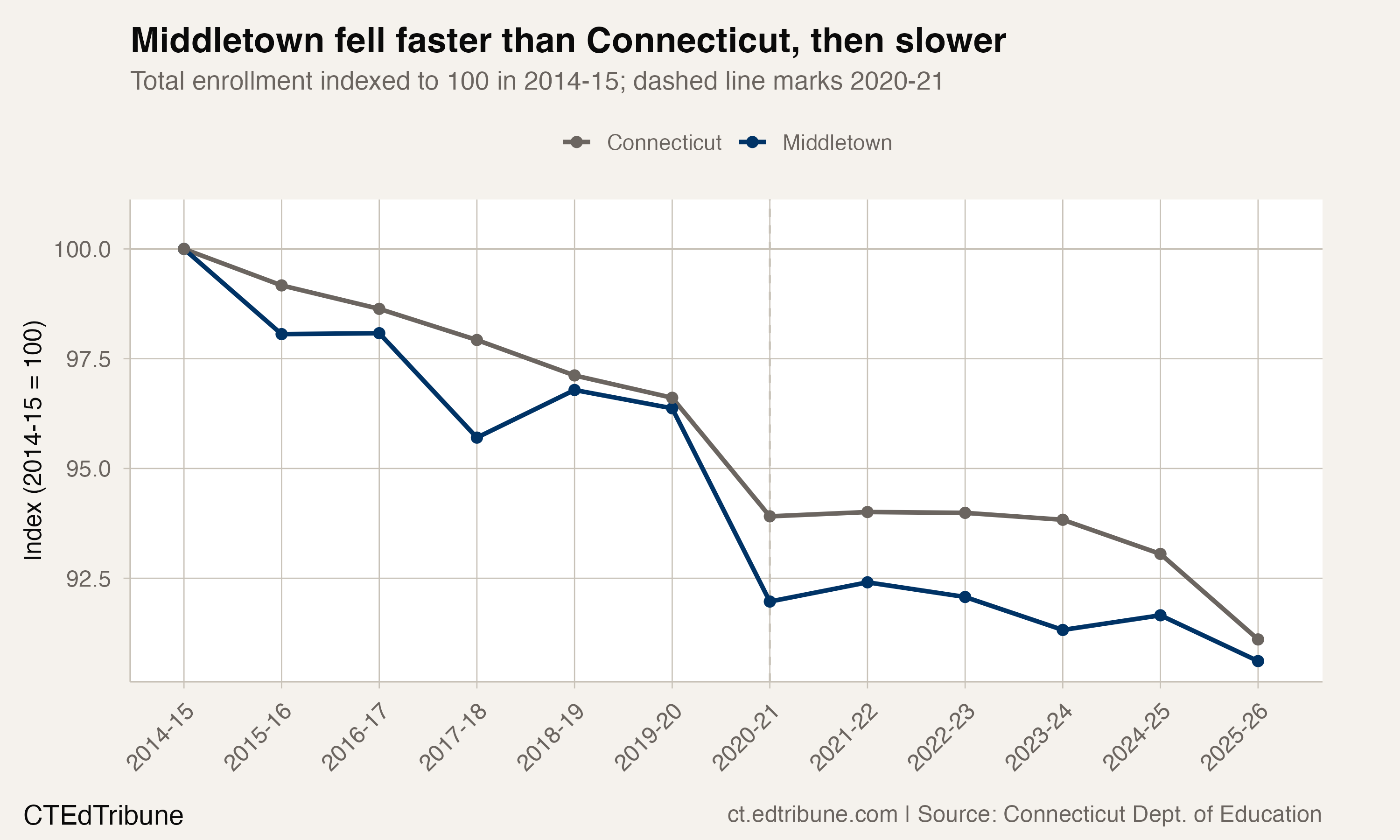
That reversal is real but it is anchored to 2020-21. Measured instead from 2018-19, Middletown is down 6.4% and the state is down 6.2%, which is a tie inside the noise. The honest version is narrow: for five straight reporting years the district has barely moved while the statewide count kept sliding, and how much credit that deserves depends on where you start counting.
One grade complicates the early-childhood picture. Kindergarten fell to 247 students in 2024-25, the lowest in the published record, and that same small cohort shows up as 243 first graders in 2025-26. Kindergarten came back to 334 in 2025-26. Whether the prekindergarten seats now filled carry into steadier kindergarten classes is a question the 2026-27 file will begin to answer when the state publishes it, and counts inside the district today will differ from these figures until then.
Who the district serves
Macary framed his case for schools to residents who have no children in them as an argument about property values and community.
"There are two reasons why people move to a city or town - property value and school systems," he wrote. "Schools are an investment in the future - our children." The district, he wrote, is "training the people who will be working in our community and preparing them to be leaders, scholars, workers - in all careers."
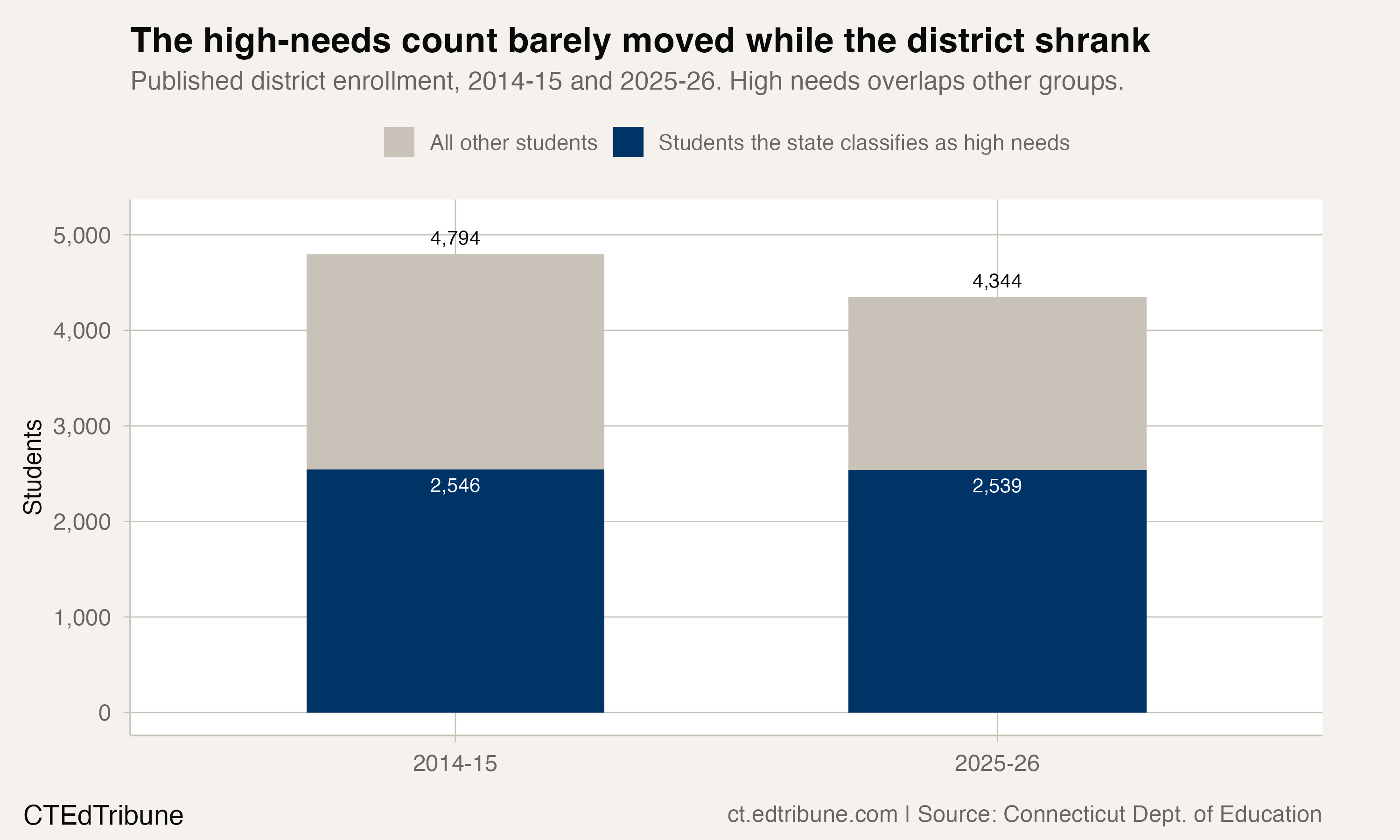
The state's own classification suggests the demand did not shrink with the district. Connecticut counted 2,546 Middletown students as high needs in 2014-15 and 2,539 in 2025-26, a difference of seven children, while total enrollment fell by 450. The share rose from 53.1% to 58.4% as a result. That series is volatile, moving as much as 10.6 percentage points in a single year, so the two endpoints are the reliable comparison rather than the path between them. The high-needs group also overlaps the special education, English learner and race categories, and is not a slice of a whole.
The composition changed underneath the total. White students went from 51.9% of the published total in 2014-15 to 36.6% in 2025-26, or 1,590 students. Hispanic enrollment rose from 17.8% to 28.2%, reaching 1,223 students. Black students numbered 863 in 2025-26, 19.9% of the district.
What the state file will not score
Macary's stated first goal is procedural rather than numerical. "My first goal is to create a culture where we 'always do what is best for students' by developing systems and structures that support student performance," he wrote, defining performance as academic, social and emotional growth. "This is what every parent wants for their own child and that's what I want for Middletown children."
He has put a calendar on it. At the district's convocation before the 2026-27 school year he outlined a 100-day entry plan built on monthly visits to every school, small-group meetings with certified teachers, and a review of central office systems, with a report of his observations due to the board in January 2027.
Connecticut's published files will not settle most of that. The state's chronic absence, assessment, graduation and staffing surfaces carry no usable 2025-26 district trend, so none of them can be put next to what he says he is watching. What they do carry is the count of children, grade by grade, and that is where his own argument lands.
"There is only one social institution in America that can make real change - schools...Remember, schools are a reflection of society," he wrote.
The prekindergarten rows are the part of that argument the state has already written down. They show a district that roughly doubled its youngest published grade while it was shrinking everywhere else. What they cannot show is whether those children stay.
Enrollment counts come from the Connecticut State Department of Education public data. Dr. Macary answered questions in writing by email; quotations and descriptions of his priorities come from that response and from the biography he supplied.
Detailed code that reproduces the analysis and figures in this article is available exclusively to EdTribune subscribers.
Discussion
Sign in to join the discussion.
Loading comments...