Jeanine Rose came to North Stonington↗ET with experience balancing the identities of different school communities. Her move from Region One to a district rooted in a single town has sharpened her interest in what families and schools share.
"For me, the opportunity is to support the schools in reflecting the very best of North Stonington while ensuring that every student has the opportunity to thrive," Rose wrote in September answers to questions from The CTEdTribune.
Rose began as superintendent this summer, succeeding Troy Hopkins. The Board of Education's appointment announcement describes a comprehensive search informed by interviews, focus groups and community surveys. The district's central office roster lists her as Superintendent of Schools.
Her early agenda, as she described it in writing, joins listening to the community with understanding the budget. She also pointed to work already underway at Wheeler Middle/High School that she hopes to learn from and build on.
Carrying school identity into a shared vision
In her answers, Rose described Region One as a system whose communities had distinct histories and traditions alongside a common curriculum, vision and mission. Preserving individual school character mattered to her there, she wrote, and remains part of her approach in North Stonington.
"I am bringing an appreciation for the importance of honoring that individuality while building a shared vision for students," she wrote. "My experience in a complex regional system taught me the value of collaboration, listening to different perspectives, and finding common ground."
The board's announcement describes responsibilities in Region One spanning curriculum, instruction, assessment, professional learning, hiring and operations. Before that, she worked in Suffield Public Schools, first as a high school English teacher, then as a secondary humanities curriculum coach and finally as an interim coordinator of curriculum and instruction. The same announcement lists her bachelor's degree in English from the University of Connecticut, a master's in English Literature and a doctorate in Educational Leadership from Central Connecticut State University.
In North Stonington, she wrote, relationships among families, schools and the town are part of the district's strength. Her description of the opportunity was to support that identity while making room for students to thrive.
A similar total, with movement along the way
The district Rose inherited enrolled 732 students last school year, 2025-26, the most recent school year in Connecticut's published enrollment data. It enrolled 741 in 2014-15. That is nine fewer students, a decline of 1.2%.
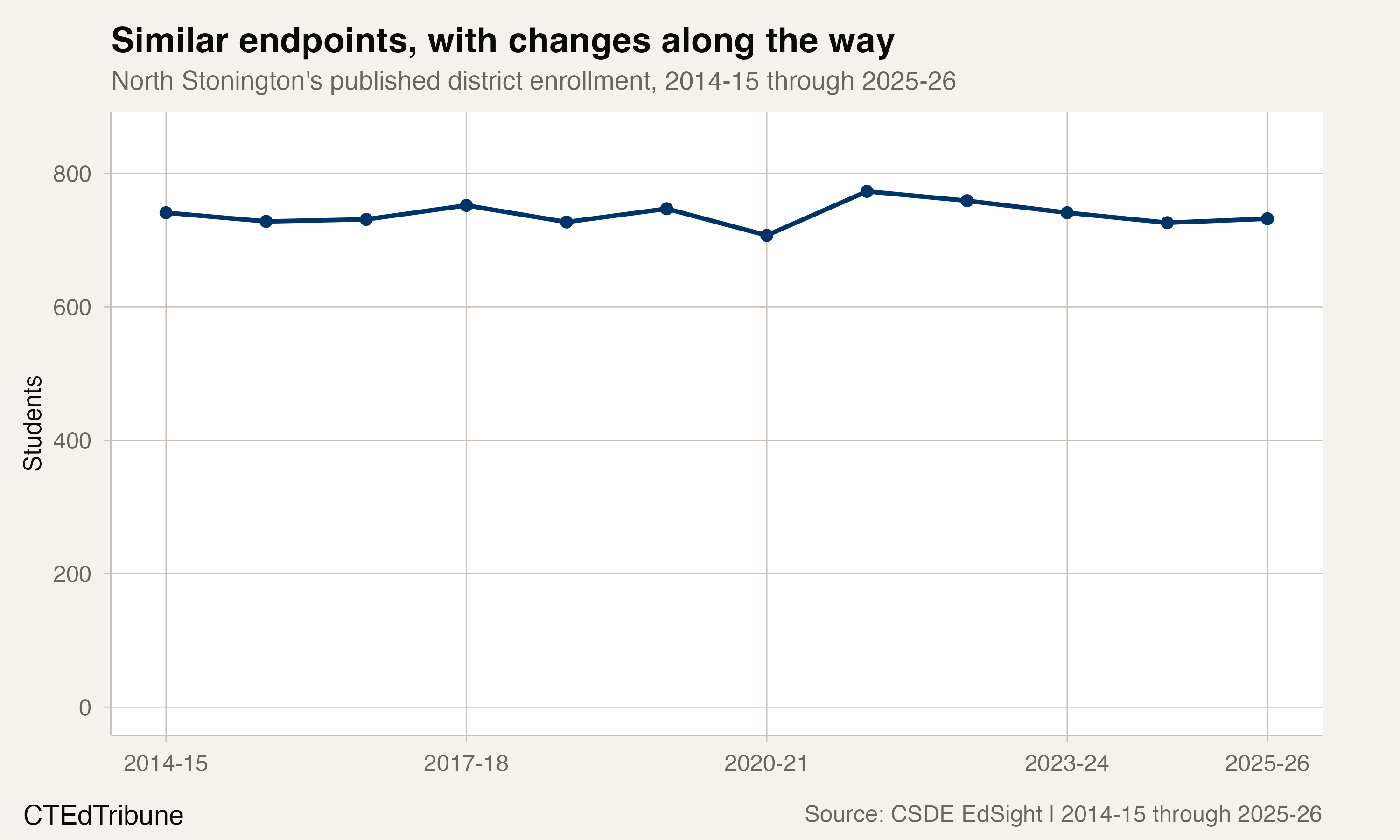
Those endpoints do not describe an unchanging district. The annual counts rose and fell between them, and the chart preserves those movements. They also predate Rose's arrival and describe the district she took on, rather than results of her leadership.
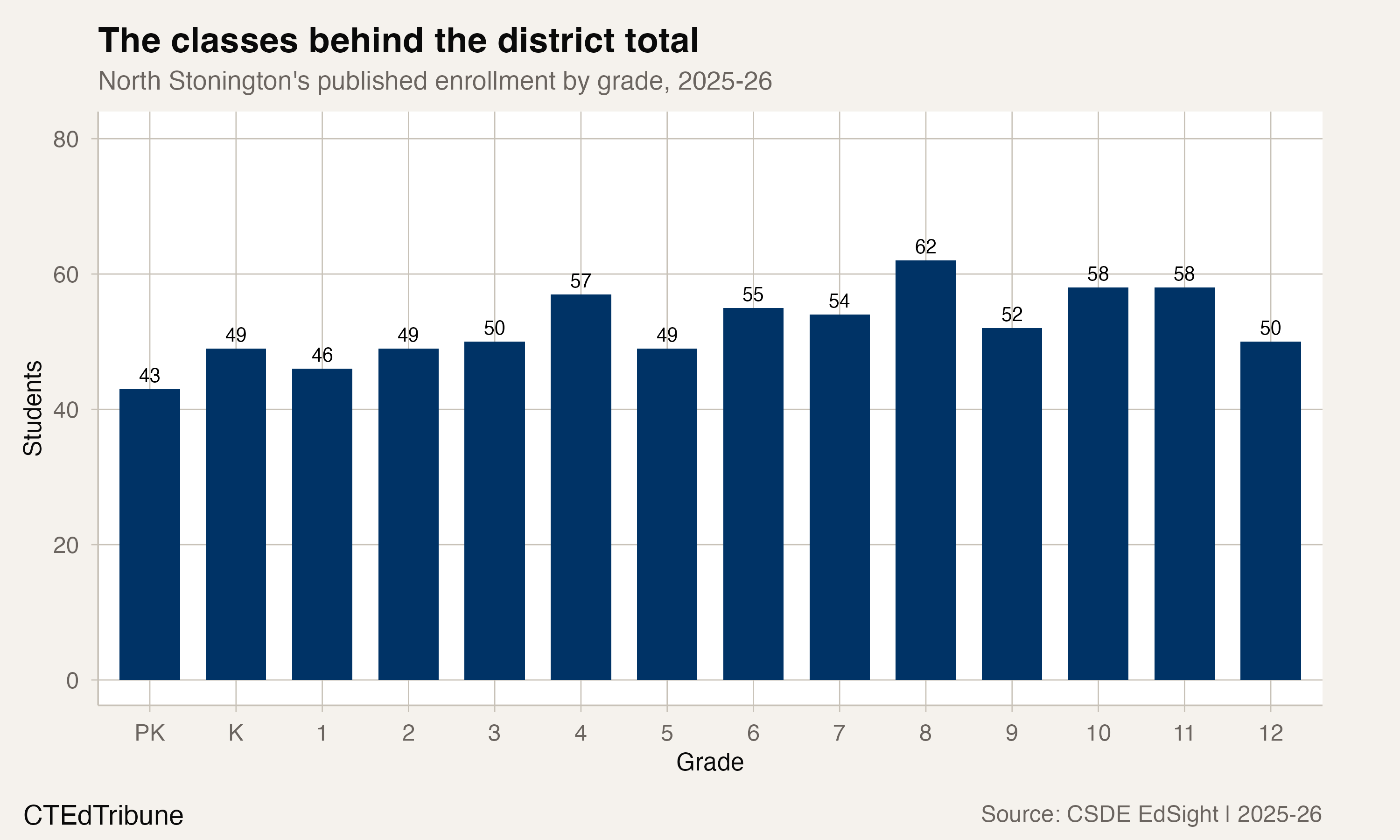
Last school year's grade counts offer another view of the planning landscape. Kindergarten held 49 students and the senior class held 50. Classes elsewhere in the district differed in size, as the grade chart shows. This is a snapshot of enrolled classes, not a prediction of how many children will enter or remain in the schools.
Learning the budget and the community together
By the time she answered in September, Rose said she had met with board members, town officials, school administrators, facilities and technology staff, union leaders, the athletic director and boosters. She described those conversations as a way to understand district strengths, challenges and community priorities.
"I want to build trust with the community and its governing agencies by being transparent, fiscally responsible, and thoughtful about how we allocate resources," she wrote.
She paired that goal with maintaining instruction, programs and services. Her stated approach is to work with the board, town leadership and staff on decisions that protect the district's financial health and students' educational opportunities.
The enrollment record gives that discussion some context. Connecticut counted 73 North Stonington students receiving special education services in 2014-15 and 116 in 2025-26. Their share of the published district total rose from 9.9% to 15.8%. These students are included in the overall enrollment count.
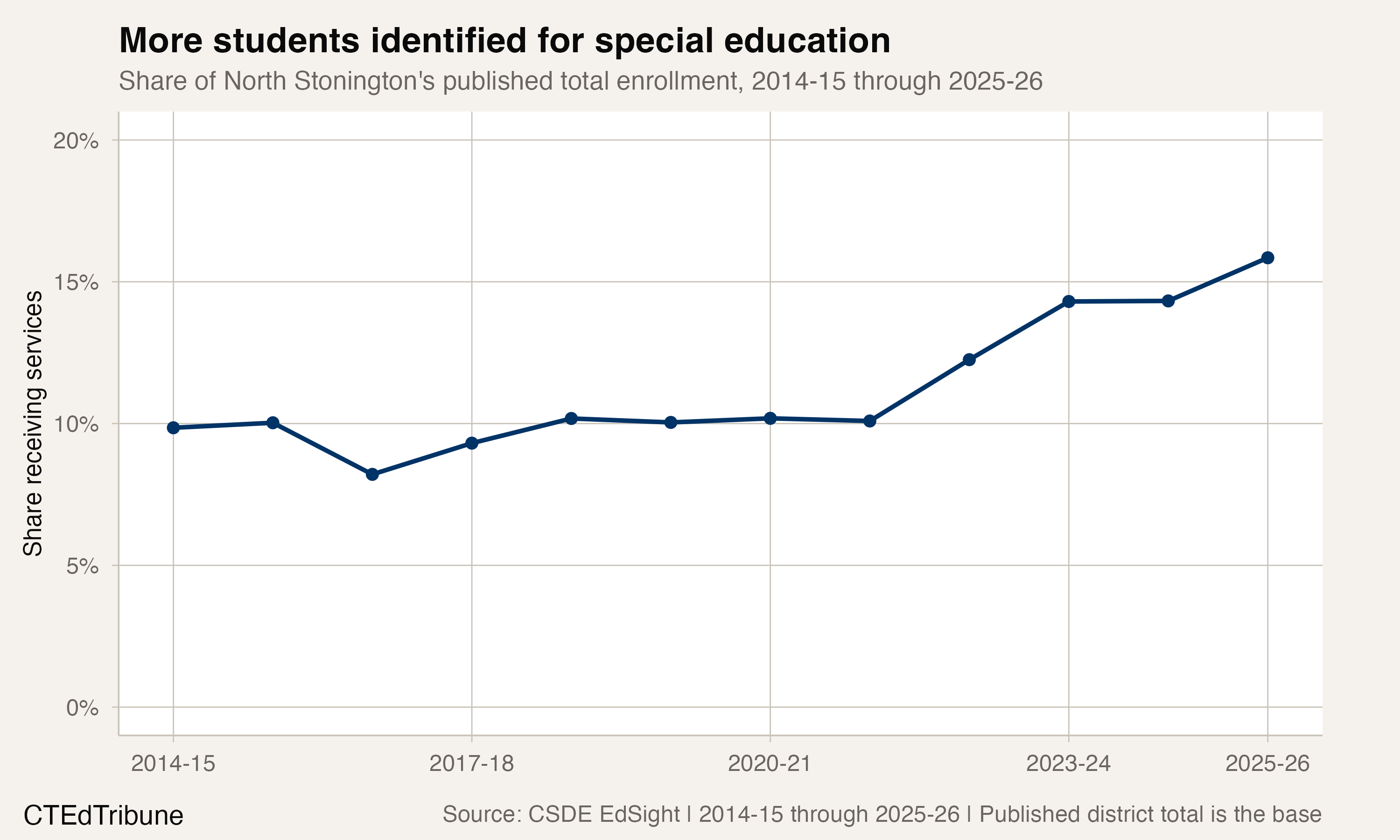
The counts establish how many students were identified for services. They do not establish why identification changed or what it cost the district. The budget priorities Rose described cannot be reduced to the overall headcount, and these figures do not prescribe a staffing or spending decision.
Building on work at Wheeler
Asked about movement beneath the district total, Rose turned to school culture. She said she was encouraged by restorative practices at Wheeler Middle/High School and wanted to understand the work more deeply.
"As a new superintendent, I am excited to learn more about the practices that have contributed to this success and to think about how we can continue to build on them across the district," she wrote.
That is her assessment and intention. The enrollment figures here do not measure school climate or establish the effects of restorative practices. The board's published goals do place belonging alongside instruction and transparent operations: students, staff and families should feel safe and valued, while district processes allow more attention to learning.
Rose's September answers bring those concerns together in a description of what she wants students to experience.
"The goal is to ensure that every student feels connected, supported, and valued, and that our schools continue to be places where students and staff can thrive," she wrote.
Enrollment figures come from the Connecticut State Department of Education. Rose answered questions in writing by email in September; quotations and descriptions of her priorities come from those answers. Career and appointment details come from the board's linked announcement.
Detailed code that reproduces the analysis and figures in this article is available exclusively to EdTribune subscribers.
Discussion
Sign in to join the discussion.
Loading comments...