Fairfield↗ET School District sits in Fairfield County, one of the wealthiest counties in the United States. Median household income exceeds $120,000. The schools are well-funded, well-staffed, and well-regarded. By every conventional measure, Fairfield should not have a chronic absenteeism problem.
It does. And it has been getting worse every year for seven years straight.
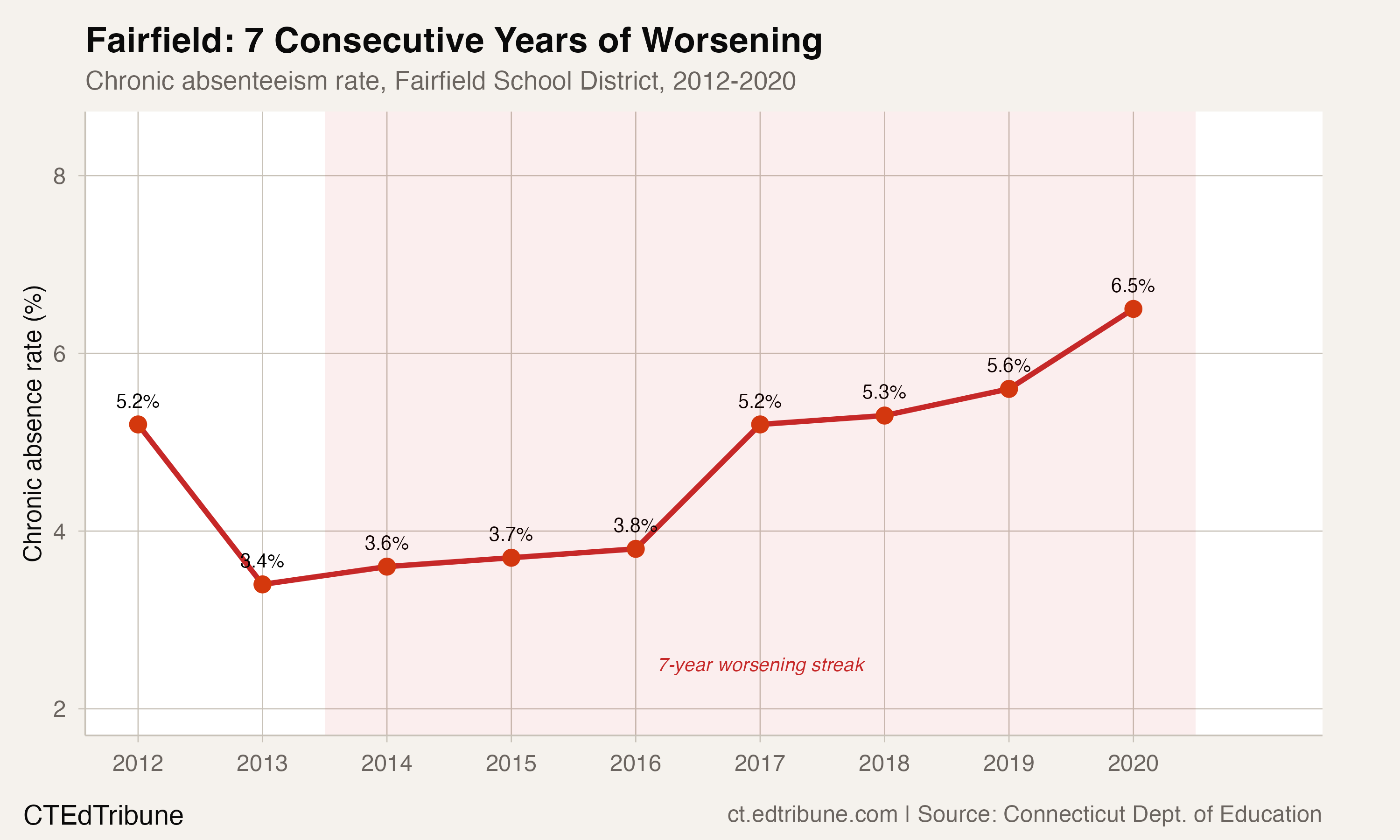
From 2014 to 2020, Fairfield's chronic absence rate increased in every single year — the longest consecutive worsening streak of any district in Connecticut's nine-year dataset. The rate nearly doubled, from 3.4% in 2013 to 6.5% in 2020.
The streak nobody else matched
Seven consecutive years of worsening chronic absenteeism is rare. The next-longest streak belongs to Achievement First Bridgeport Academy at six years (2013-2018), and only Sterling School District also reached five. Most districts oscillate -- a bad year followed by a good year, a dip followed by a spike. Fairfield just kept climbing.
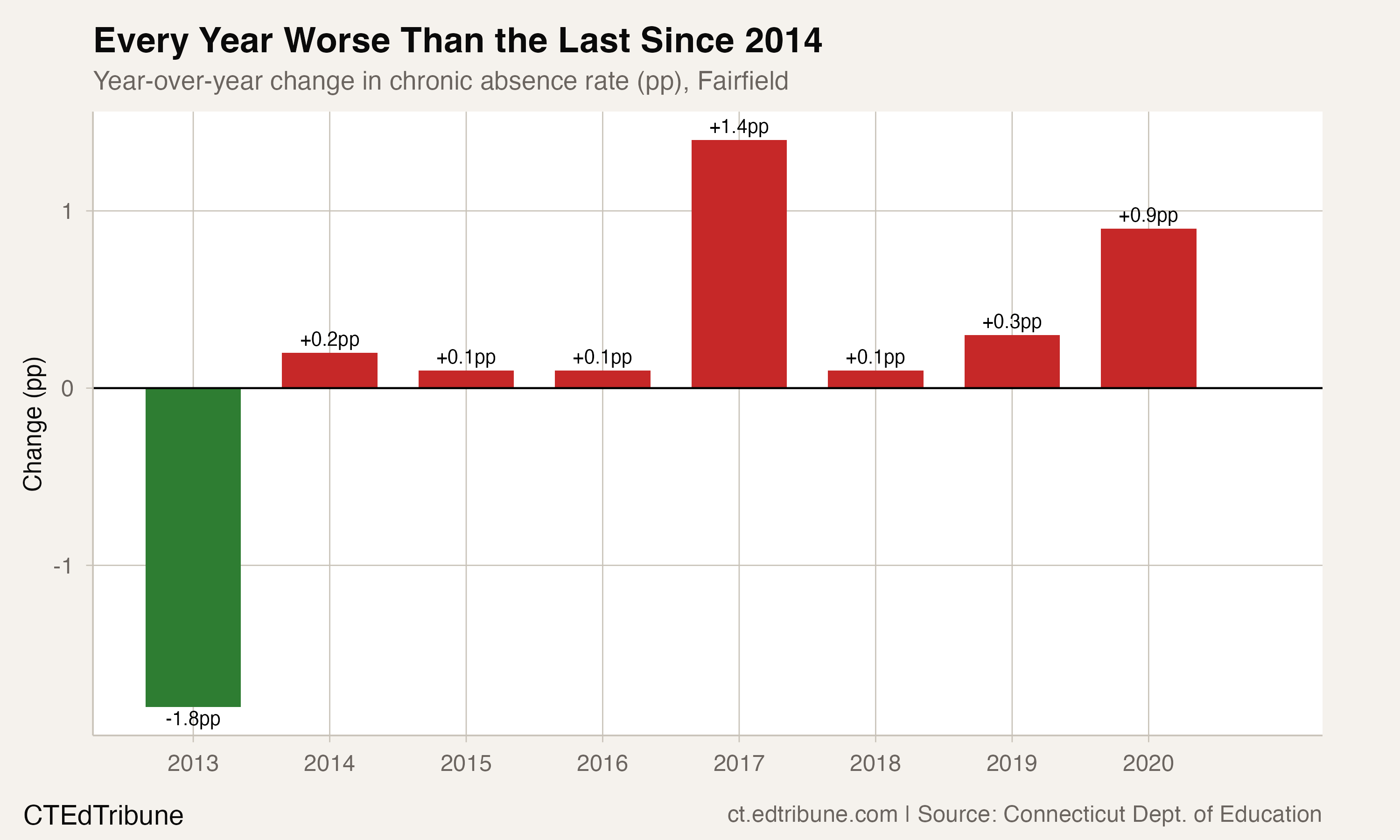
The increments were small in some years — just 0.1 percentage points from 2014 to 2015, and again from 2015 to 2016. But 2017 brought a 1.4-point jump that pushed the rate from 3.8% to 5.2%, and the rate never came back down. By 2020, at 6.5%, Fairfield was nearly double its 2013 trough of 3.4%.
Still below average — but converging
Fairfield's 6.5% rate in 2020 remains well below the statewide average of 12.2%. In absolute terms, this is a district with manageable chronic absence. The story is not that Fairfield is in crisis. It is that Fairfield is moving in the wrong direction, year after year, while the question of why goes unanswered.
The gap between Fairfield and the state average has been narrowing. In 2013, Fairfield's rate was 8.1 points below the state figure. By 2020, the gap had shrunk to 5.7 points. If the worsening trend continued through the pandemic years — which web research cannot confirm for Fairfield specifically — the district may have converged further.
The affluent-suburb paradox
Fairfield's trajectory challenges a common assumption in chronic absenteeism research: that attendance problems are primarily driven by poverty, transportation barriers, and housing instability. Those factors undeniably matter — Hartford's 27.9% rate and its correlation with high poverty make that clear. But Fairfield eliminates those variables and still cannot reverse its trend.
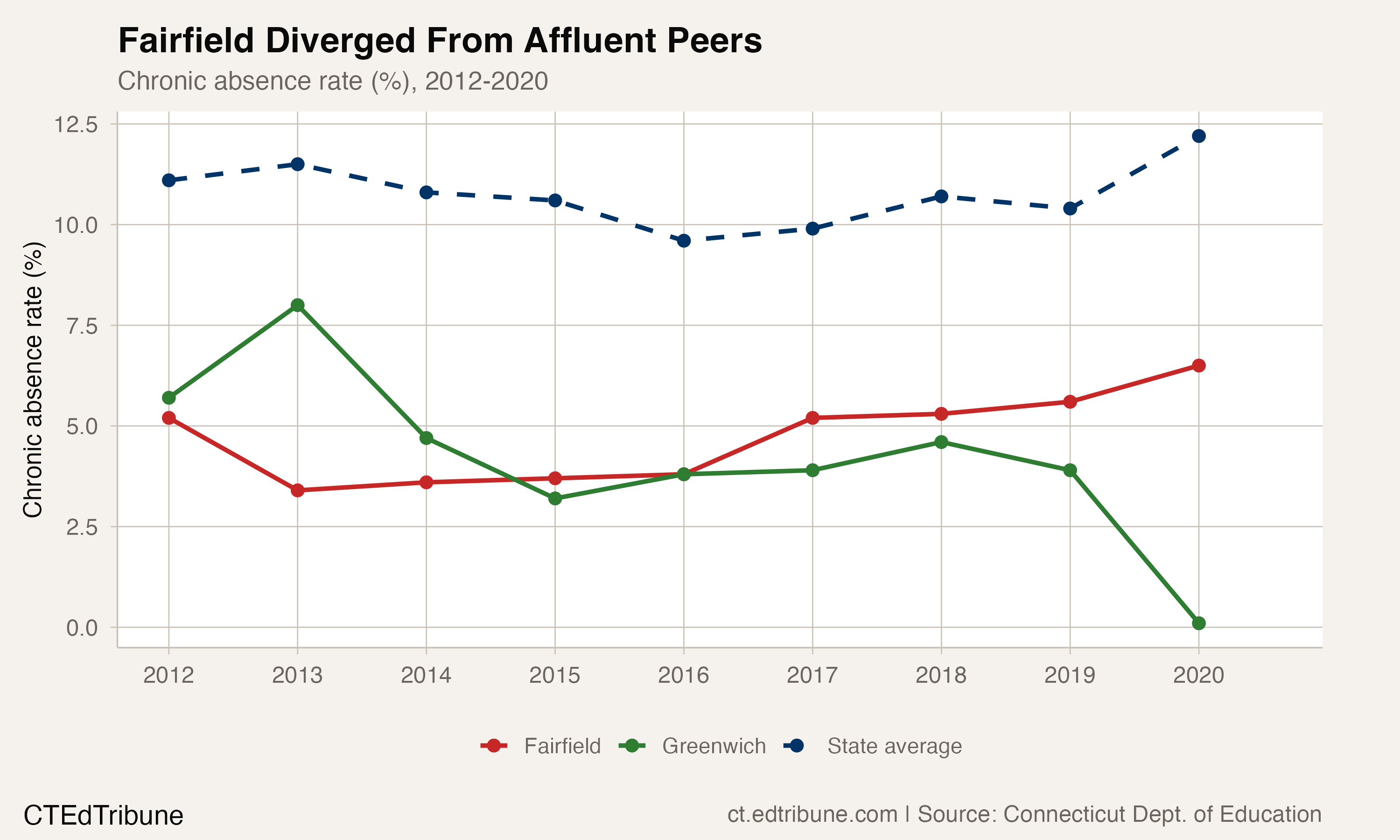
Among Fairfield County's wealthiest districts, the picture in 2020 was mixed. Ridgefield↗ET and Westport↗ET posted higher rates than Fairfield — 8.5% and 8.4% respectively — suggesting the problem extends beyond a single district. Darien↗ET (5.2%), Weston (5.4%), and New Canaan (5.9%) were close behind. Only Wilton (4.4%) and Greenwich↗ET (0.1%) stood clearly apart.
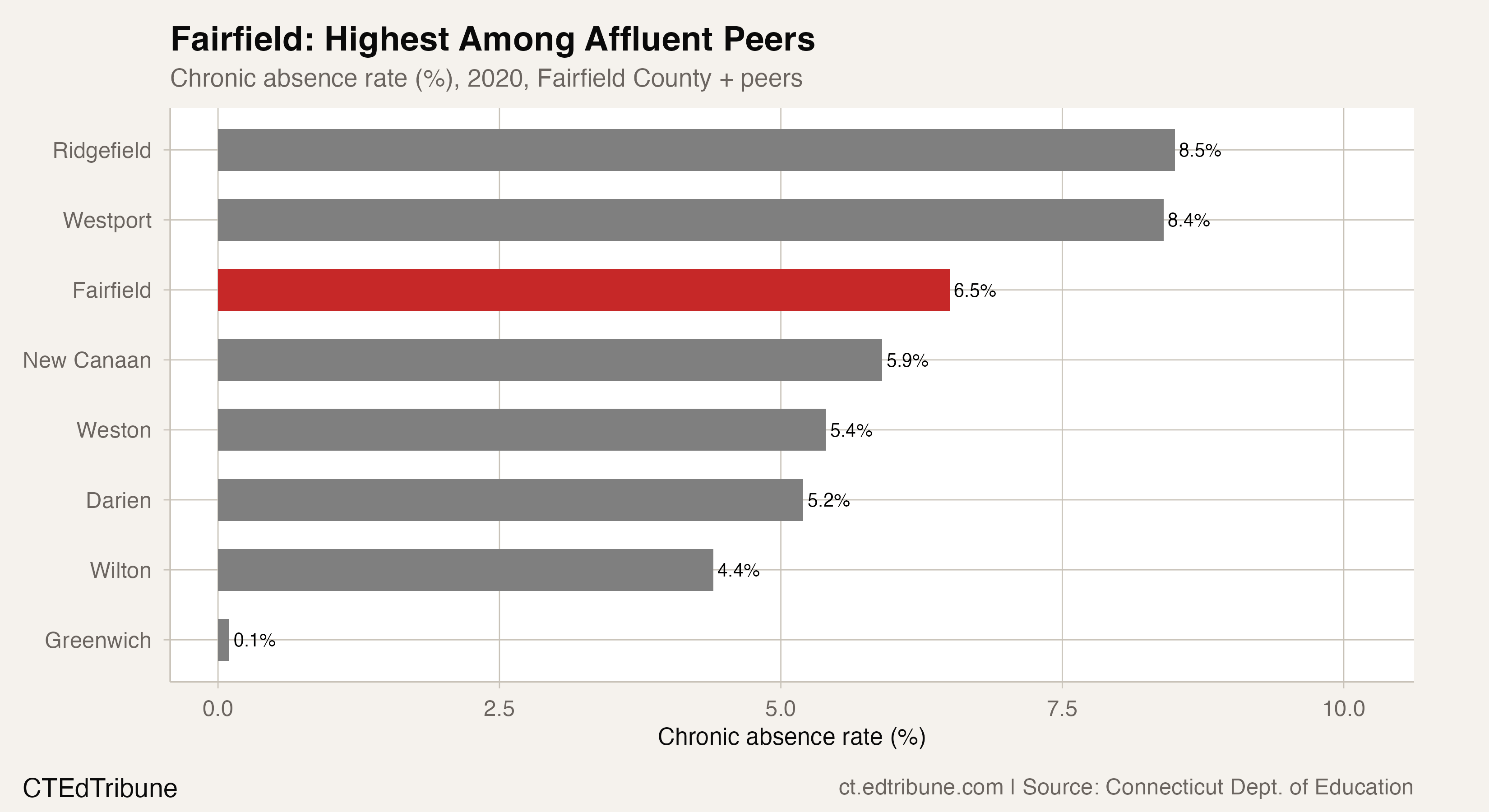
The change from 2013 to 2020 tells a more revealing story. Westport's rate more than tripled, from 2.5% to 8.4% — a larger absolute increase than Fairfield's. Ridgefield, Darien, and New Canaan all worsened. The only affluent districts that improved were Weston (-2.4 points), Greenwich (-7.9 points), and Wilton (-12.4 points). The worsening trend was not unique to Fairfield. It was widespread among wealthy suburbs, with Fairfield distinguished mainly by the consistency of its climb.
What might be driving it
The data cannot explain the cause, but three hypotheses deserve consideration.
The first is the rise in mental health-related absences. Connecticut counts mental health wellness days as absences for chronic absenteeism purposes, and the state's Department of Education has noted that anxiety-related school avoidance has increased across affluent and non-affluent districts alike. If affluent families are more likely to seek mental health diagnoses — and more likely to keep children home when anxiety symptoms emerge — the worsening trend could reflect changing norms around acceptable reasons to miss school.
The second is the growth of permissive absence cultures. In districts where academic performance is high and college admissions outcomes are strong, the perceived cost of missing a day of school is low. A family vacation, a college visit, a travel sports tournament — these absences accumulate differently in affluent communities, where they are less likely to trigger alarm.
The third is a measurement artifact: as Connecticut tightened its chronic absenteeism tracking and reporting requirements after 2015, districts may have improved their counting, capturing absences that previously went unrecorded. Fairfield's worsening could partly reflect better measurement rather than worse attendance.
None of these hypotheses is confirmed by the available data. They probably all contributed something.
A hundred more kids, every year
In raw numbers, Fairfield's streak is modest -- the difference between 3.4% and 6.5% translates to roughly 100 additional students who are chronically absent in a district of about 10,000. But the consistency is the point.
If attendance gets worse every year for seven straight years in a wealthy, well-resourced district, then whatever is driving the national chronic absenteeism crisis is not limited to poverty. It reaches communities where the usual explanations -- transportation barriers, housing instability, lack of healthcare access -- do not apply.
The pandemic would amplify these forces dramatically. Connecticut's statewide rate more than doubled to 23.7% by 2021-22. The pre-COVID data from Fairfield suggests the attendance problem was already spreading beyond the districts where policy attention was focused. It just took a pandemic to make everyone notice.
Detailed code that reproduces the analysis and figures in this article is available exclusively to EdTribune subscribers.
Discussion
Sign in to join the discussion.
Loading comments...