The 2019-20 school year ended abruptly. Connecticut closed its schools in March 2020, cutting the academic calendar by roughly three months. Fewer school days should mean fewer chances to miss enough days to be labeled chronically absent.
Instead, the opposite happened. Connecticut's statewide chronic absenteeism rate climbed to 12.2% — its highest point in nine years of data — and 78 of 187 districts with available data hit their own all-time highs. The worst part: this was just the opening act. By 2021-22, the rate would more than double to 23.7%.
The mid-decade improvement that vanished
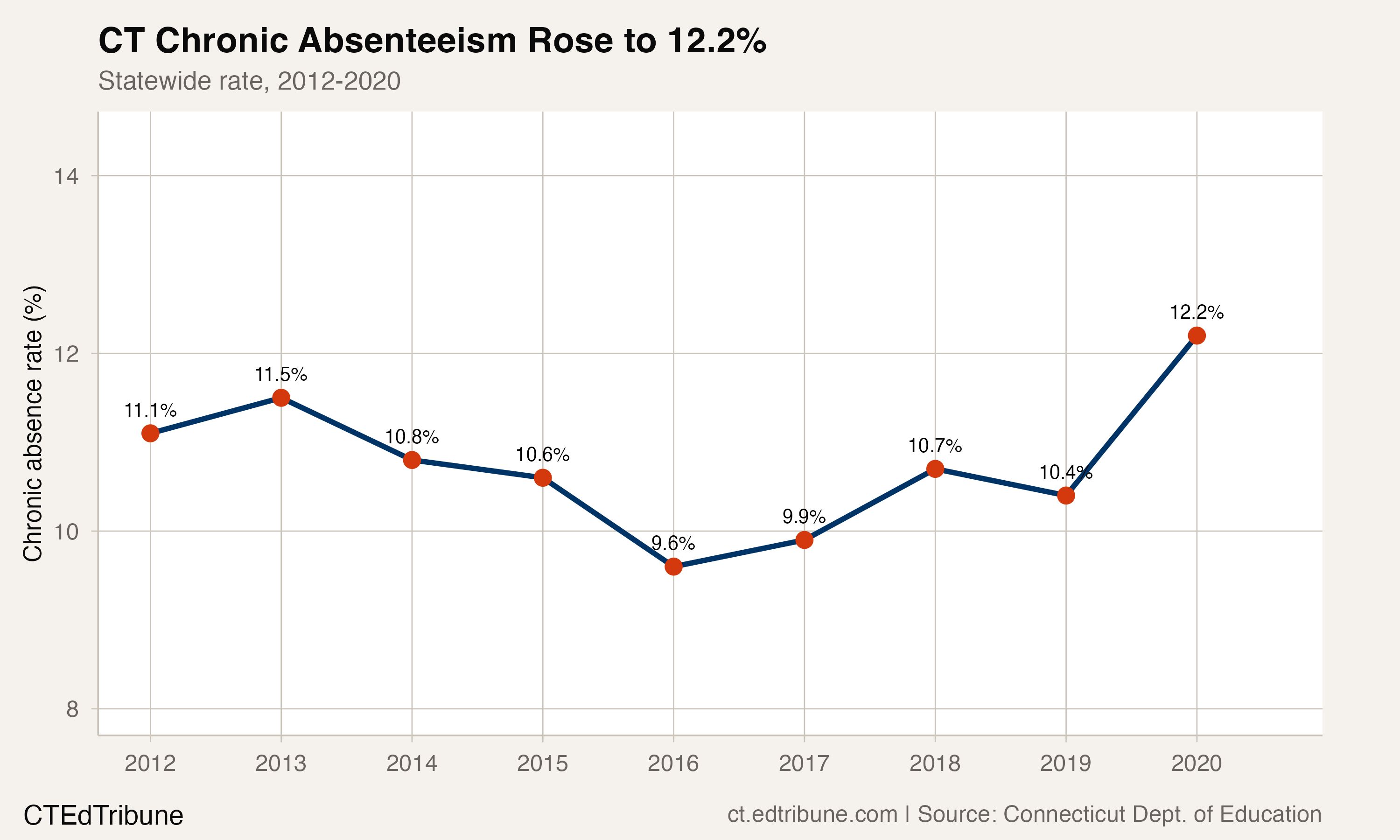
Connecticut's attendance story is a V-shaped trap. The statewide chronic absence rate fell from 11.1% in 2012 to a trough of 9.6% in 2016 — a 1.5 percentage-point improvement that coincided with new truancy legislation (Public Act 15-225) and heightened attention to attendance tracking. For four years, the numbers moved in the right direction.
Then they reversed. The rate crept back up: 9.9% in 2017, 10.7% in 2018, a brief dip to 10.4% in 2019, and the 12.2% spike in 2020. By the time COVID closed schools, Connecticut had already erased all its mid-decade progress and then some. The 2020 rate exceeded the 2012 starting point by 1.1 percentage points.
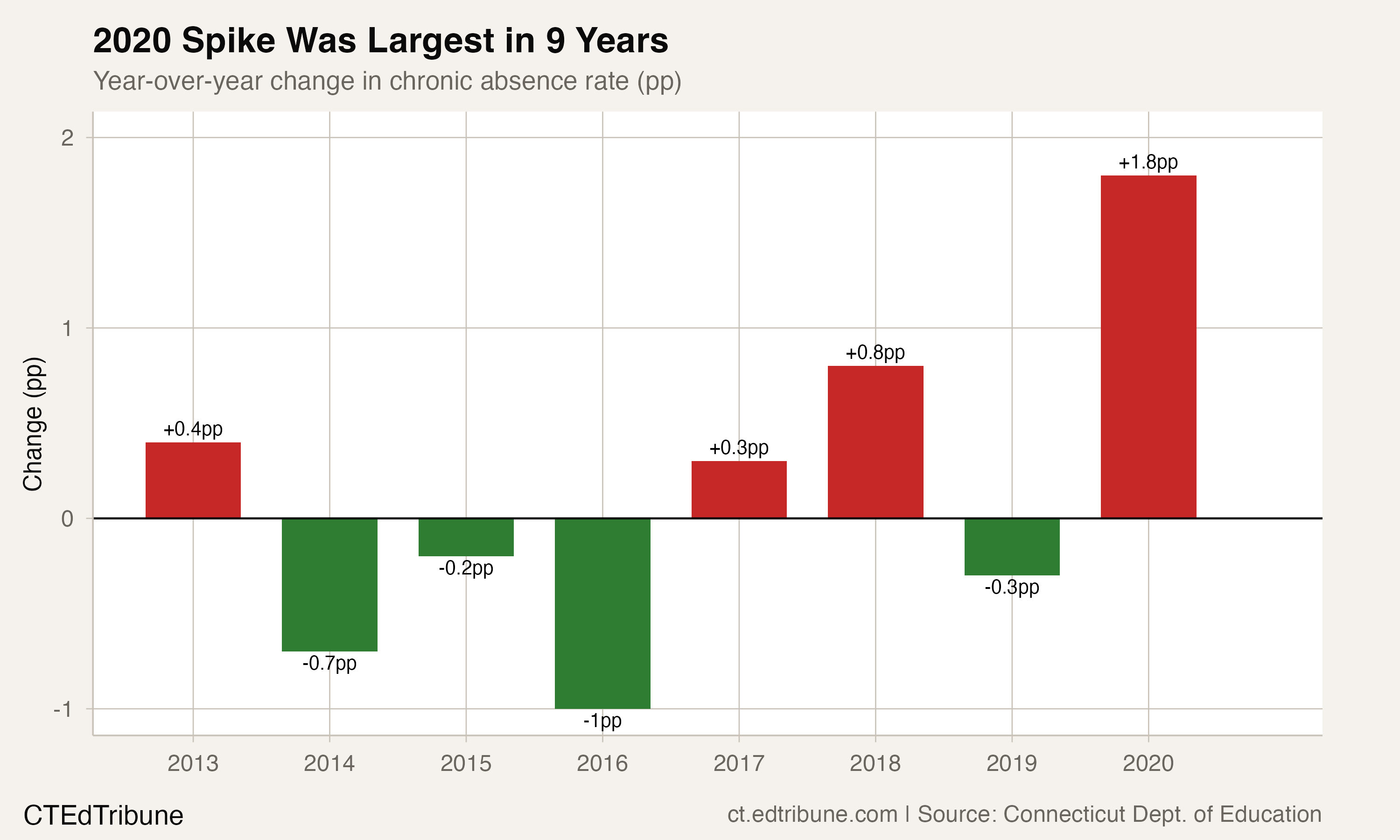
The 2020 spike of +1.8 percentage points was the largest single-year jump in the nine-year dataset. But the reversal started earlier. The +0.8 percentage-point increase in 2018 was the second-largest, and it came during a full, uninterrupted school year — no pandemic, no closures, no excuses.
138 of 165 districts worsened in a shortened year
The 2020 spike was not concentrated in a few urban districts. Using a gender-averaged proxy that extends coverage to 165 districts, 138 — 84% — saw their chronic absenteeism rate increase from 2019 to 2020, averaging a 1.9 percentage-point jump.
Only 27 districts improved.
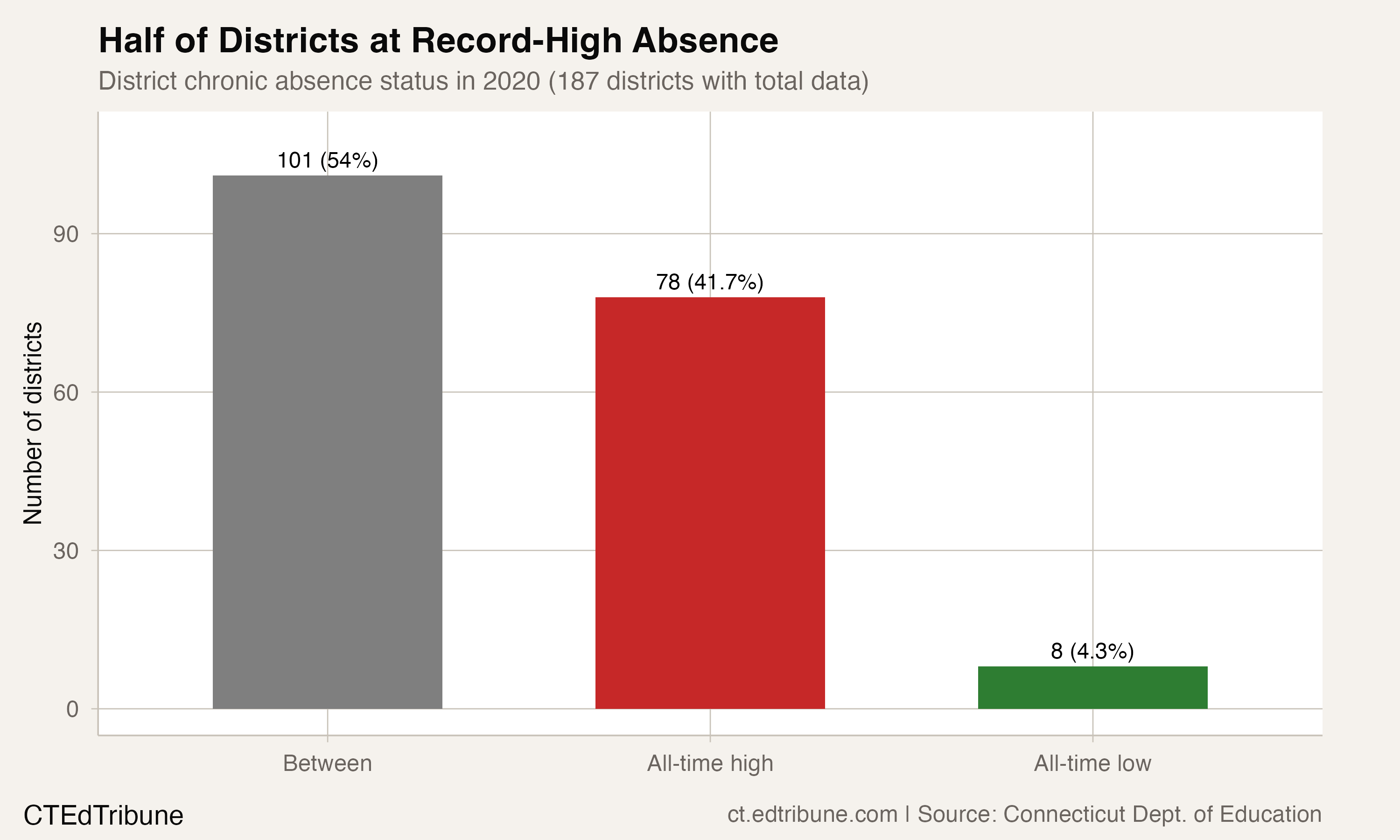
Among 187 districts reporting total chronic absence data across at least five years, 78 — 42% — hit their all-time worst chronic absence rate in the COVID-shortened 2020. Just 8 reached their all-time low.
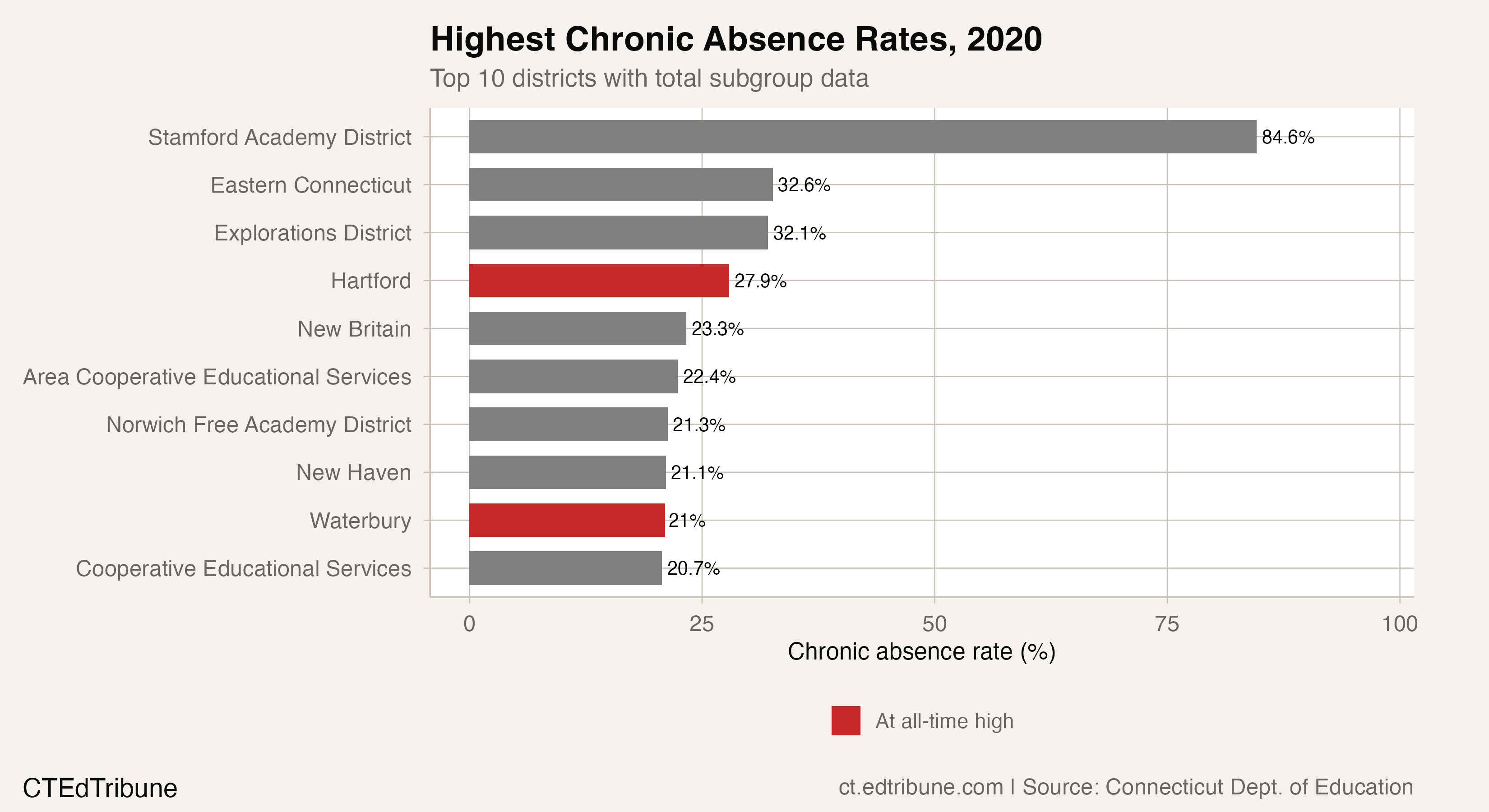
The districts at their worst included familiar names: Hartford↗ET at 27.9%, Waterbury↗ET at 21.0%, Capitol Region Education Council at 20.5%. But the list also included smaller districts that rarely make headlines — Sterling↗ET at 19.1%, Thompson↗ET at 17.8%, Coventry↗ET at 12.7%, Sherman↗ET at 9.6%. The crisis was not just urban.
A paradox that has never been fully explained
The 2020 finding is counterintuitive. The state defines chronic absenteeism as missing 10% or more of school days in a year. With schools closing in March 2020, students had roughly 120 days of instruction instead of the usual 180. Missing 12 days would make a student chronically absent rather than the usual 18.
Several explanations compete. The most straightforward: the students who were already marginally attending simply stopped before schools officially closed. Families dealing with economic disruption, health fears, or lack of childcare pulled children out in late February and early March 2020, before governors issued closure orders. A Fox 61 investigation found that chronic absenteeism was already rising during the pandemic as families navigated uncertainty.
An alternative explanation: the lower denominator made chronic absence easier to trigger. With fewer total days, even a modest number of absences crossed the 10% threshold. This statistical artifact would make the 12.2% rate look worse than it truly was in behavioral terms.
Both explanations are likely true simultaneously, and the data cannot disentangle them.
What the baseline reveals about the recovery
The pre-COVID data matters because it defines the target. Connecticut's chronic absenteeism rate peaked at 23.7% in 2021-22, then declined to 17.2% by 2024-25 — a three-year recovery driven partly by the state's LEAP home-visitation program, which paired trained community members with chronically absent families and produced a 15 percentage-point attendance improvement within six months of intervention.
"Students in pre-K through fifth grade experienced an eight percentage point increase in attendance nine months after the first LEAP visit, while students in grades six through 12 experienced a sixteen percentage point increase." — Education Commission of the States, 2023
But 17.2% is still 65% above the pre-COVID baseline of 10.4% in 2019 — and the pre-COVID baseline was itself higher than the 9.6% trough of 2016. The recovery is real. It is also incomplete relative to where the state was before the pandemic, which was itself worse than the best the state had achieved.
The trough was fragile
The most sobering implication: Connecticut's mid-2010s improvement was not durable. The state spent four years getting chronic absenteeism from 11.1% to 9.6%, then gave it all back in four more. Whatever drove the improvement -- legislative attention, better reporting, genuine intervention -- did not create a new floor.
The current recovery is powered by $10.7 million in federal COVID recovery funds and $7 million in annual state allocations for LEAP. The program's evidence base is strong -- it was featured as a national best practice by the federal Department of Education in 2023, and more than 30,000 students have returned to regular attendance. But the federal recovery funds will expire. And the pre-COVID data offers a clear warning about what happens when the money and attention move on.
Detailed code that reproduces the analysis and figures in this article is available exclusively to EdTribune subscribers.
Discussion
Sign in to join the discussion.
Loading comments...