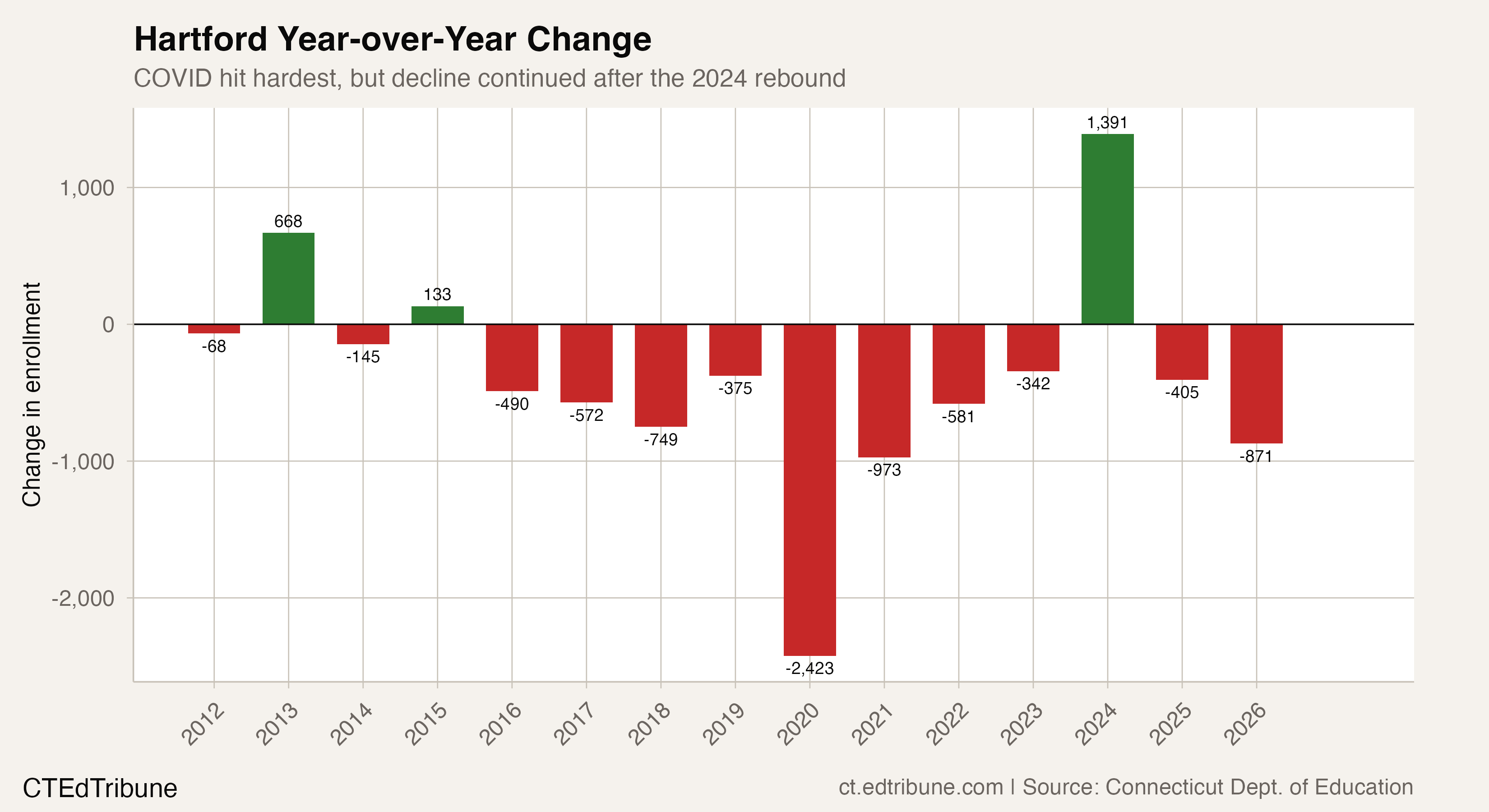
Correction (July 26, 2026): An earlier version of this article drew its COVID-era figures from Connecticut's TOTAL enrollment row before that row was reconciled to the EdSight October enrollment census. The 2020 through 2023 counts in the source undercounted students by 16,000 to 19,500 statewide. Three figures have been corrected: Hartford's 2019 to 2021 loss was 2,034 students (10.3%), not 3,396 (17.2%); Hartford fell to fourth-largest in 2021, not 2020; and the 2024 change was an increase of 65 students, not 1,391, so the district's decline paused for a year rather than reversing. The headline thesis, the 15-year loss of 5,802 students, and the CREC comparison were not affected.
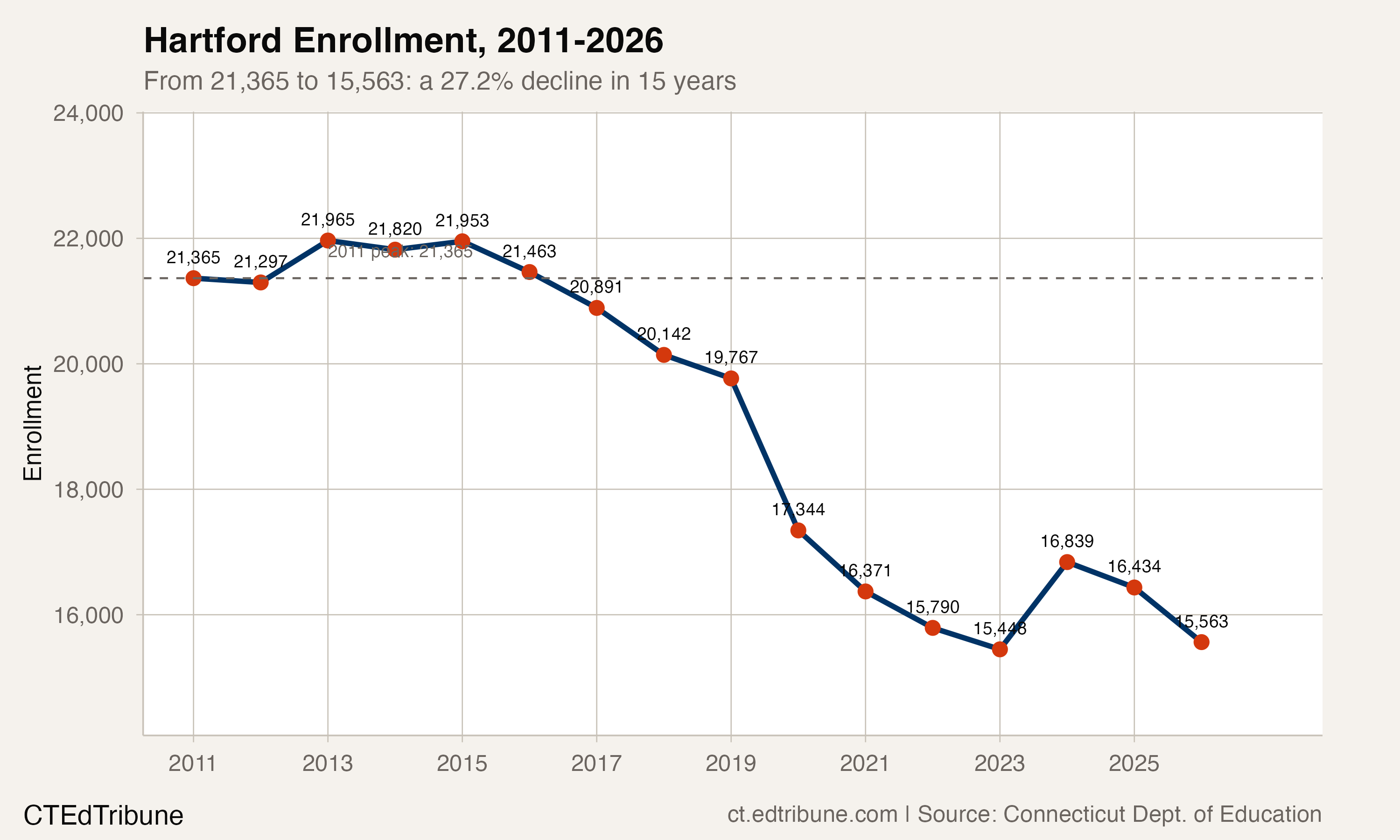
In 2011, Hartford↗ET was the undisputed center of gravity in Connecticut public education. At 21,365 students, it was the state's largest school district, leading Bridgeport↗ET by nearly 1,000 students and New Haven↗ET by more than 1,100.
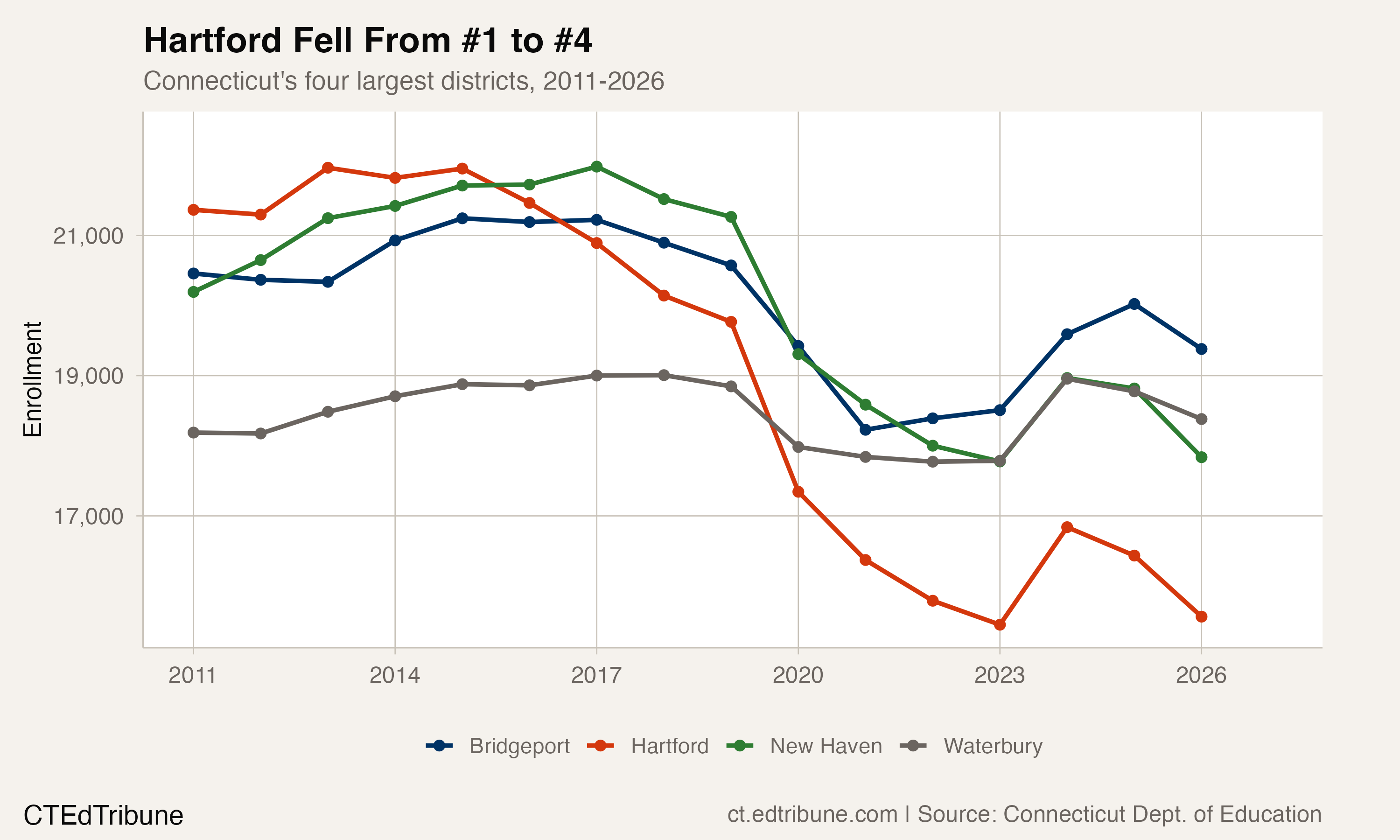
Fifteen years later, Hartford enrolls 15,563 students. It has lost 5,802 of them, a 27.2% decline that dropped it to fourth-largest in the state. Bridgeport, Waterbury↗ET, and New Haven all now enroll more students. Hartford's decline is more than double the statewide rate of 11.8% over the same period, and unlike its peers, Hartford never stabilized. It fell from first to second in 2016, to third by 2017, and to fourth by 2021, where it has remained.
The district is now under state intervention, facing a $35 million budget deficit and maintaining buildings constructed for twice their current enrollment. In January 2026, city leaders launched a public survey to gather input on potential school closures and consolidations. The question is no longer whether Hartford's school system will shrink further. It is how the district manages the contraction.
The steepest fall among the Big Four
Hartford's trajectory is striking because its three peers weathered the same statewide headwinds with far less damage. Bridgeport lost 5.3% over the same 15-year span. Waterbury actually grew by 1.1%, adding 193 students. New Haven declined 11.7%, roughly in line with the state average.
Hartford lost more students than Bridgeport, New Haven, and Waterbury combined.
The gap opened widest during COVID. Between 2019 and 2021, Hartford lost 2,034 students, a 10.3% drop in just two years. That two-year collapse alone exceeds the total 15-year losses of Bridgeport and Waterbury put together. While Bridgeport and Waterbury partially recovered after the pandemic, Hartford never did: enrollment paused for a single year in 2024, adding 65 students, then resumed falling with losses of 405 in 2025 and 871 in 2026, pushing the district to a new low.
A parallel system built from a court order
The most distinctive force acting on Hartford's enrollment is one that does not exist for the state's other large districts. In 1996, the Connecticut Supreme Court ruled in Sheff v. O'Neill that Hartford's racially segregated public schools violated the state constitution. The remedy was not to fix Hartford's schools directly but to create a parallel system: interdistrict magnet schools operated by the Capitol Region Education Council, plus an Open Choice program that buses Hartford students to suburban districts.
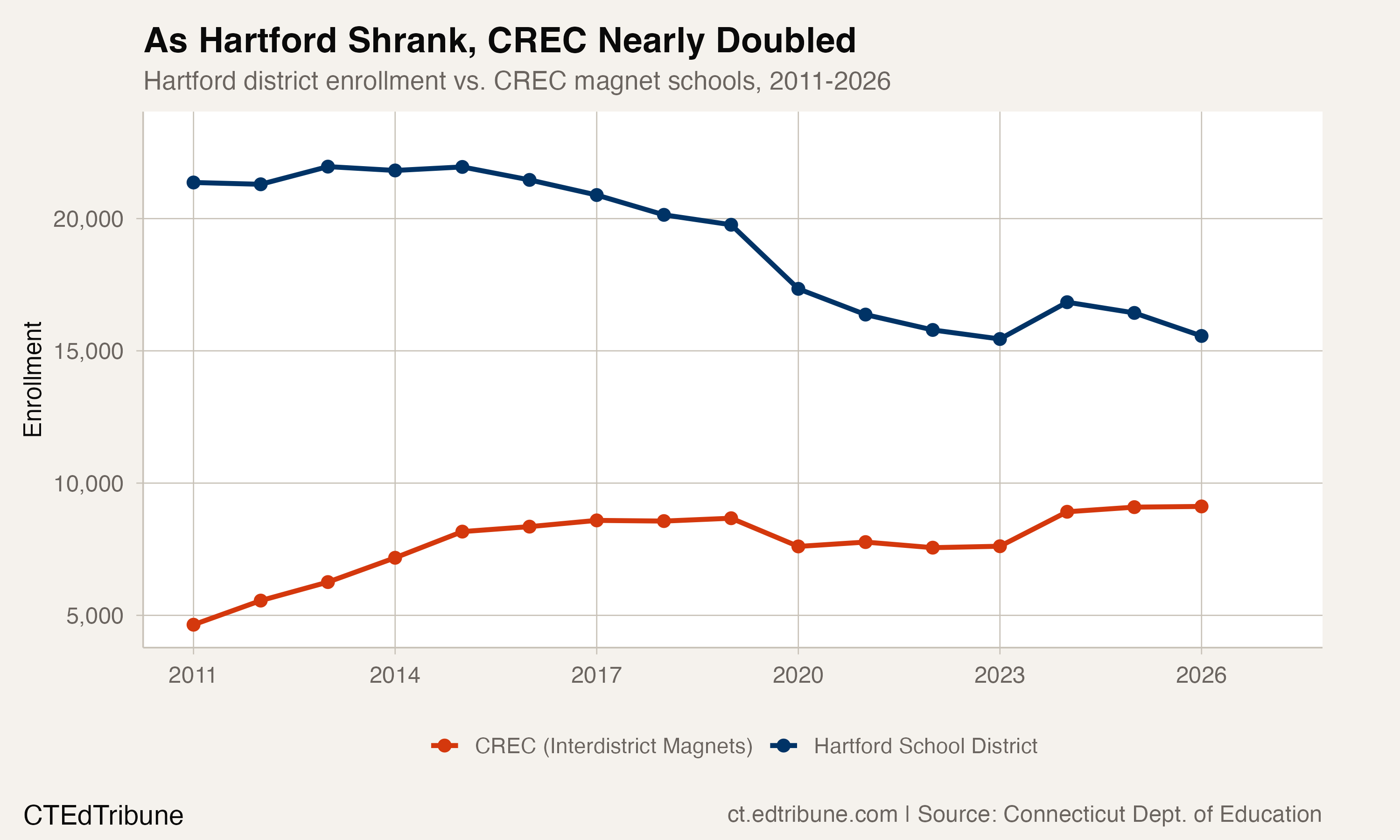
CREC's enrollment tells the other half of Hartford's story. In 2011, CREC enrolled 4,646 students. By 2026, that figure had nearly doubled to 9,118, a 96.3% increase. As Hartford's traditional district shed students, the magnet system absorbed many of them. About half of all children living in Hartford now attend schools outside the traditional district, either through CREC magnets or Open Choice.
The state recently announced it has exceeded the 95% benchmark in the Sheff settlement, meeting 96% of Hartford families' demand for placement in interdistrict choice programs. But that milestone has drawn criticism from within Hartford itself.
"Every time we place a child in another magnet school the money follows the child and Hartford gets that much less." — Carol Gale, Hartford Federation of Teachers president, Hartford Courant, Dec. 2025
Hartford Board of Education chairperson Shonta Browdy called meeting the placement benchmark "a rather narrow victory" while educational disparities persist.
The budget math of emptying buildings
The fiscal consequences are compounding. Hartford entered the 2025-26 school year projecting a $30 million shortfall driven by rising special education tuition, transportation costs, and new collective-bargaining obligations. The board approved $21.3 million in cuts, eliminating more than 100 positions including assistant principals, office staff, and programs supporting over-age, under-credited students. A remaining $6.7 million gap required additional requests to the city and state.
"Every year the board cuts services our children need to pass a budget. We have already cut to the bone. Now we are cutting through it." — Shontá Browdy, Hartford Board of Education member, Connecticut Public, April 2025
In October 2025, Mayor Arunan Arulampalam announced a transformation planning process that put school closures on the table. "Hartford's school funding dollars should support students, not empty buildings, or inefficient back-office services," the mayor said. The district hired Caissa K12, a Memphis-based student recruitment firm, under a contract paying $935 per student recruited, capped at $500,000. The goal: bring back some of the more than 9,000 students who left through school choice programs. That a school district is paying a consulting firm a bounty per student to recruit families back is itself a measure of how deep the crisis runs.
The kindergarten signal
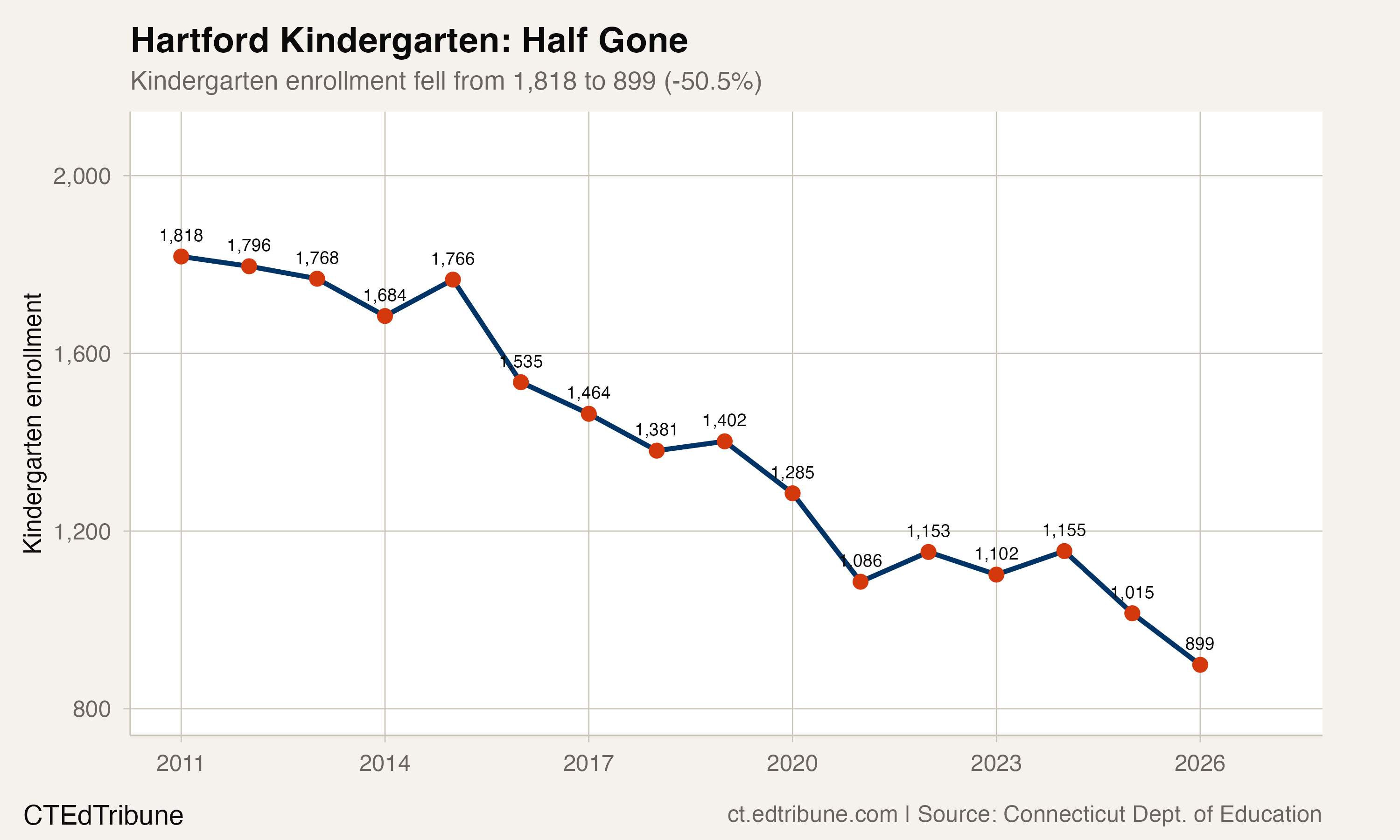
Hartford's kindergarten enrollment has been cut in half. In 2011, 1,818 kindergartners enrolled. In 2026, that number was 899, a 50.6% decline that far outpaces the district's overall 27.2% loss. The kindergarten trend is the leading indicator: it signals smaller cohorts flowing through the system for the next 12 years. Hartford's 12th-grade class in 2026 was 1,070 students, still larger than the incoming kindergarten class. The pipeline is narrowing at the entry point.
The most plausible driver is the interaction between school choice and demographic change. Families with young children may be making the choice to enter CREC magnets or Open Choice at kindergarten, bypassing the traditional district entirely. Birth rate declines across Hartford and the broader region are also a factor, though the 50.6% kindergarten drop far exceeds what birth rates alone would explain.
An ELL reversal after a decade of growth
Hartford's English learner population had been one of the few bright spots. LEP enrollment grew from 3,751 (17.6% of the district) in 2011 to 4,313 (26.2%) in 2025, increasing even as total enrollment fell. But in 2026, LEP enrollment dropped to 3,925, a loss of 388 students in a single year.
The timing aligns with a statewide pattern: for the first time in over a decade, multilingual student enrollment fell across Connecticut in October 2025, with advocates citing fears of immigration enforcement. Hartford Superintendent Andraé Townsel pointed to multiple factors including immigration-related concerns at the federal level, shifting migration patterns, housing availability, and the school choice drain.
One in four Hartford students is classified as an English learner. Whether the 2026 drop is a one-year anomaly driven by federal policy fears or the start of a new trend will shape both the district's demographics and its state funding allocation.
What to watch
Hartford's special education population tells the structural story in miniature. The district enrolled 3,002 special education students in 2011 (14.1% of enrollment) and 3,281 in 2026 (21.1%). Total enrollment fell 27.2%, but special education enrollment grew 9.3%. More than one in five Hartford students now receives special education services, and the instructional programs those students are entitled to carry per-pupil costs that do not decline when enrollment does.
The state's ECS formula reached full funding in fiscal year 2026, two years early. A hold-harmless provision means Hartford does not lose state funding as enrollment drops, at least for now. But hold-harmless is a floor, not a growth mechanism. If Hartford continues losing 500 to 900 students per year while maintaining buildings and specialized staffing levels designed for 21,000, the structural mismatch between revenue and obligation will widen.
The next test comes with the 2028-29 Sheff settlement deadline, when the state has committed to meeting 100% of Hartford families' demand for choice placements. If the state succeeds, it will mean more students have access to integrated, well-funded schools. It will also mean the traditional Hartford district has fewer students left to serve.
Detailed code that reproduces the analysis and figures in this article is available exclusively to EdTribune subscribers.
Discussion
Sign in to join the discussion.
Loading comments...