In 2011, nearly two out of three students in Connecticut's public schools were white. In 2020, the share crossed below 50% for the first time. Six years later, it stands at 44.7%, and the gap between white enrollment and everybody else continues to widen.
This is not a story about one group replacing another. It is a story about a state whose student body has been reshaped by two simultaneous forces: a steep, unrelenting decline in white enrollment and a sustained surge in Hispanic enrollment that has partially, but not fully, offset the losses. Connecticut lost 66,739 students between 2011 and 2026, an 11.8% decline. White enrollment alone dropped by 124,518. Without growth among Hispanic, multiracial, and Asian students, the state would have lost more than twice as many.
A 15-Year Slide With One Interruption
White enrollment in Connecticut has fallen every year since at least 2011, with a single exception. From 347,090 students in 2011 to 222,572 in 2026, the trajectory has been consistent: annual losses of 8,000 to 9,500 students through the pre-pandemic years, a sharper drop of 18,024 during the COVID disruption of 2020, and a return to losses of 6,000 to 7,500 in the years since.
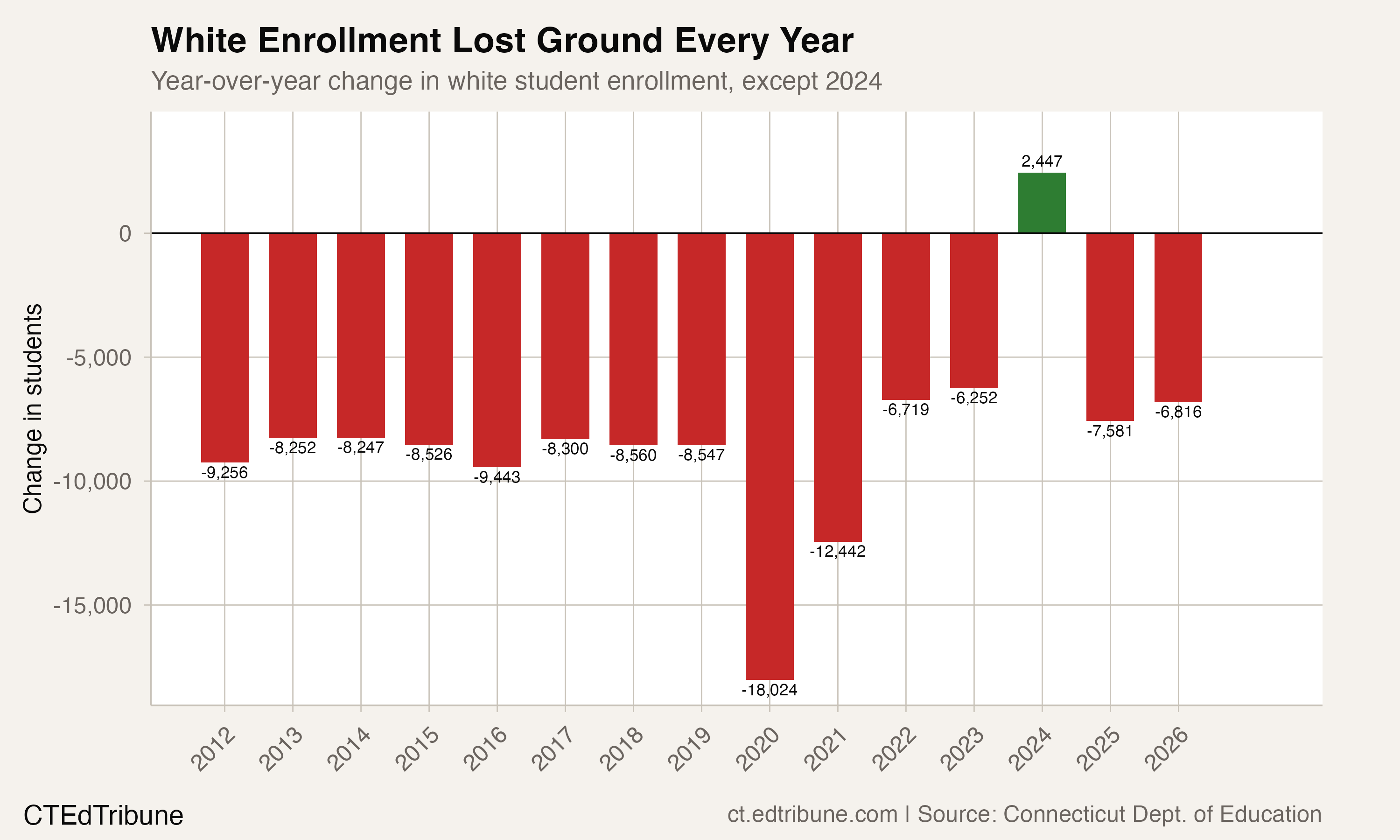
The lone exception came in 2024, when white enrollment ticked up by 2,447 students, the only gain in the 16-year series. The reversal was short-lived. White enrollment dropped by 7,581 in 2025 and another 6,816 in 2026, erasing the gain and then some.
The 50% threshold fell in 2020, when white students comprised 49.2% of enrollment. By 2026, the share had dropped another 4.5 percentage points to 44.7%.
Connecticut's decline in white student share is among the steepest in the nation. Between 2012 and 2022, the white share of public school enrollment fell by roughly 12 percentage points, a drop matched only by Massachusetts and larger than any other state.
Hispanic Growth as Partial Counterweight
While white enrollment has contracted by 35.9%, Hispanic enrollment has moved in the opposite direction, growing from 107,617 students in 2011 to 161,618 in 2026, a 50.2% increase. Hispanic students now account for 32.5% of Connecticut's public school population, up from 19.1% fifteen years ago.
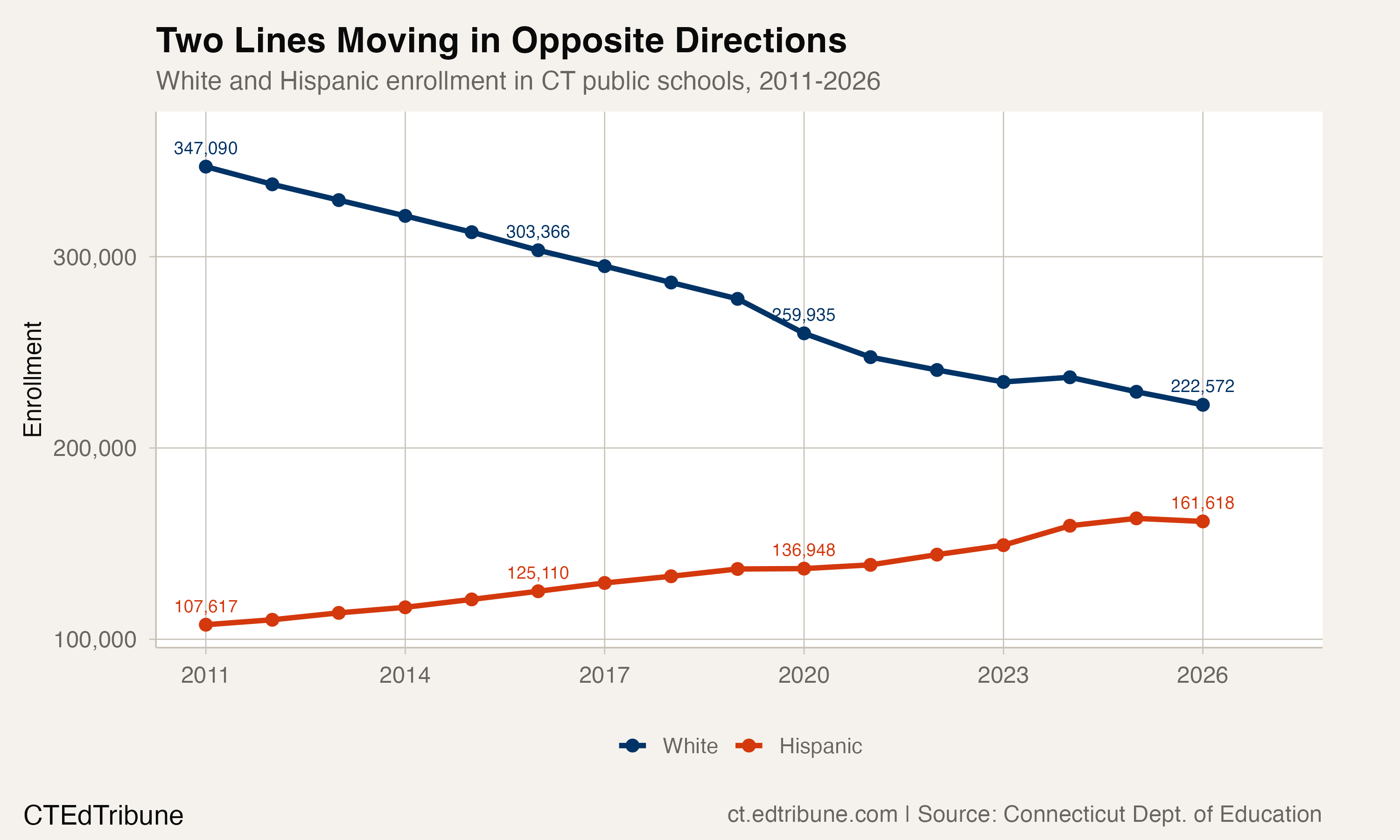
The white-Hispanic gap has narrowed from 42.4 percentage points in 2011 to 12.2 points in 2026. At the average rate of closure over the past 15 years (about two percentage points per year), Hispanic students would become the plurality group by the early 2030s.
But the "growth" framing requires context. Hispanic enrollment actually dipped slightly in 2026, falling by 1,592 students from its 2025 peak of 163,210. Whether this represents normal fluctuation or the beginning of a deceleration is too early to say.
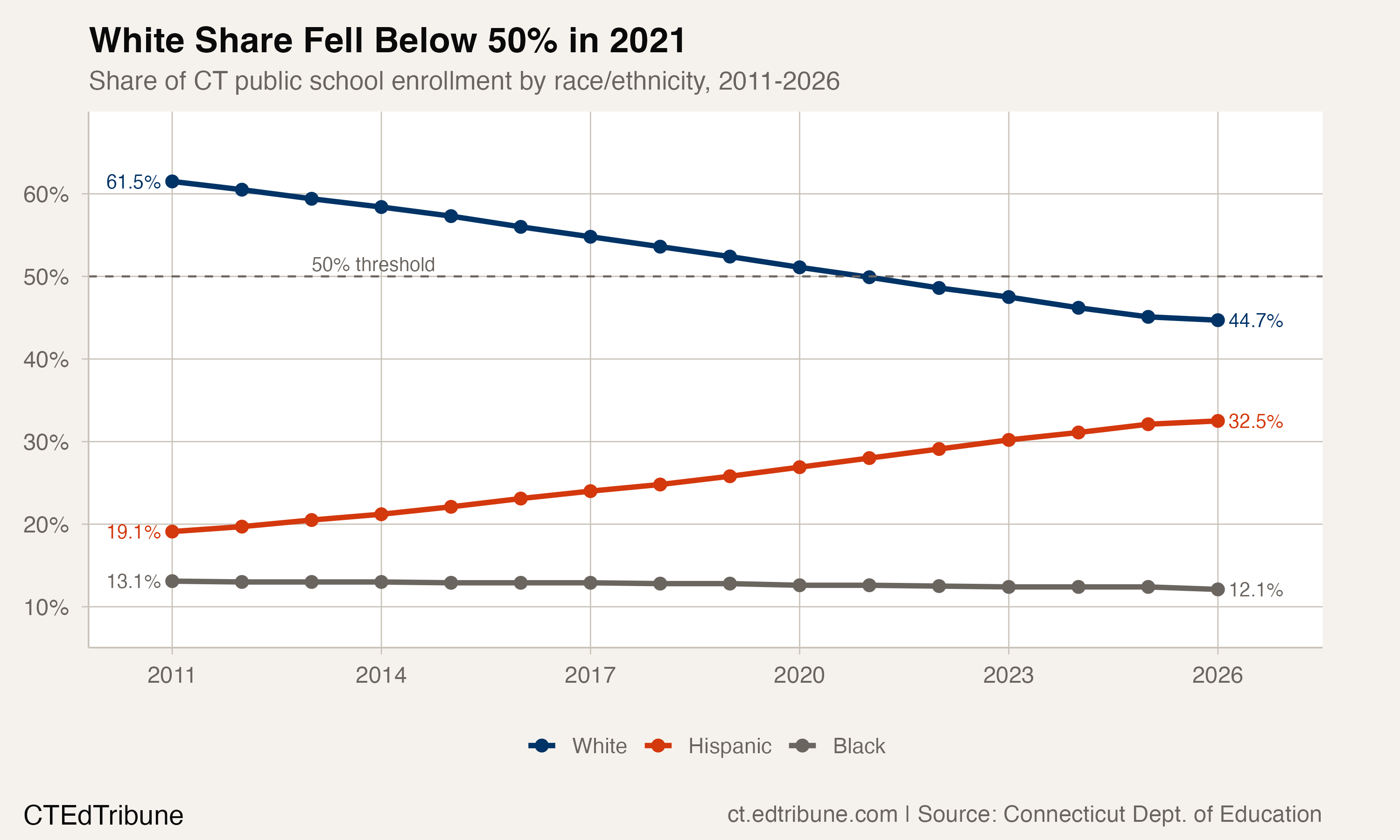
Black enrollment, meanwhile, has declined steadily, falling from 74,071 (13.1%) to 60,406 (12.1%) over the same period, an 18.4% drop. The fastest-growing group by percentage is multiracial students, who have surged from 9,225 (1.6%) to 24,533 (4.9%), a 165.9% increase, though they remain a small share of the total.
What Is Driving the Shift
The white enrollment decline reflects both fewer white children entering the pipeline and white families leaving public schools. Connecticut's median age climbed from 37 to 41 between 2000 and 2024, driven partly by low birth rates among white residents and partly by outmigration of younger families. The pre-pandemic losses of 8,000 to 9,500 white students per year were too large to be explained by birth rates alone; private school enrollment, homeschooling, and interstate moves all likely contributed, though the enrollment data cannot separate these factors.
Hispanic population growth across the state has been substantial. There were 80,000 more Hispanic or Latino residents in Connecticut in 2023 than in 2018, a roughly 14% increase. More than 120 towns saw growth in their Hispanic population during that period, even as many experienced overall population decline. Connecticut's relative affordability compared to New York City and Boston has made it a destination for Latino families priced out of those metro areas.
"We have to make it easier for people to get into college and stay in college. A lot of Puerto Ricans and Latinos enter college, but they don't graduate." -- Charles Venator Santiago, UConn Professor, CT Public, April 2024
The quote points to a broader tension: Connecticut's Hispanic student population is growing rapidly, but the educational infrastructure serving these students still lags on outcomes like college completion.
15 Districts Crossed the Line
The statewide shift masks enormous variation at the district level. Fifteen districts that were majority-white in 2011 had crossed below 50% by 2026. The largest swing occurred in East Haven↗ET, where the white share plummeted from 75.0% to 40.9%, a 34.1-point drop. South Windsor↗ET fell from 75.8% to 42.5%. Derby↗ET dropped from 56.6% to 24.0%.
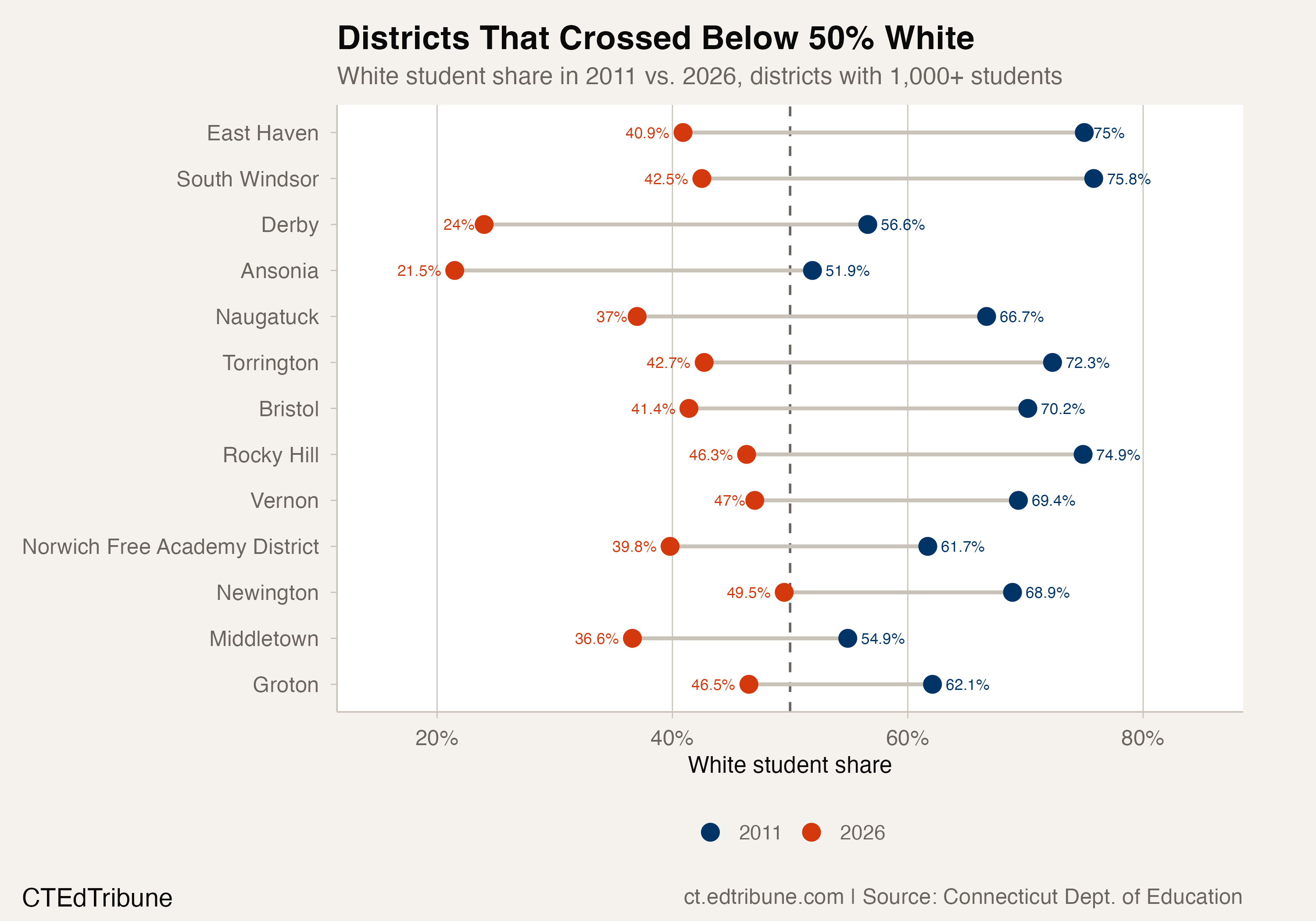
These are not Hartford or Bridgeport. They are mid-sized towns in the suburban ring, places where the demographic transformation has unfolded quietly over a decade and a half. Bristol↗ET (70.2% to 41.4%), Torrington↗ET (72.3% to 42.7%), and Naugatuck↗ET (66.7% to 37.0%) followed the same pattern.
Among districts with available data in both years, the number of majority-minority districts grew from 27 in 2011 to 42 in 2026, a 56% increase. The shift has been especially rapid in the five largest Hispanic-majority districts: Windham↗ET (72.0% Hispanic), New Britain↗ET (68.3%), Danbury↗ET (66.7%), Waterbury↗ET (64.7%), and Meriden↗ET (62.4%).
Danbury illustrates the speed of the transformation. In 2011, the district was 44.7% white and 37.2% Hispanic. By 2026, those numbers had inverted: 19.0% white, 66.7% Hispanic. The district added 3,658 Hispanic students in absolute terms, the largest gain of any district in the state.
The Suburban Frontier
The shift is not confined to cities and former mill towns. Even Connecticut's wealthiest suburbs have seen meaningful declines in white share, though from very different starting points.
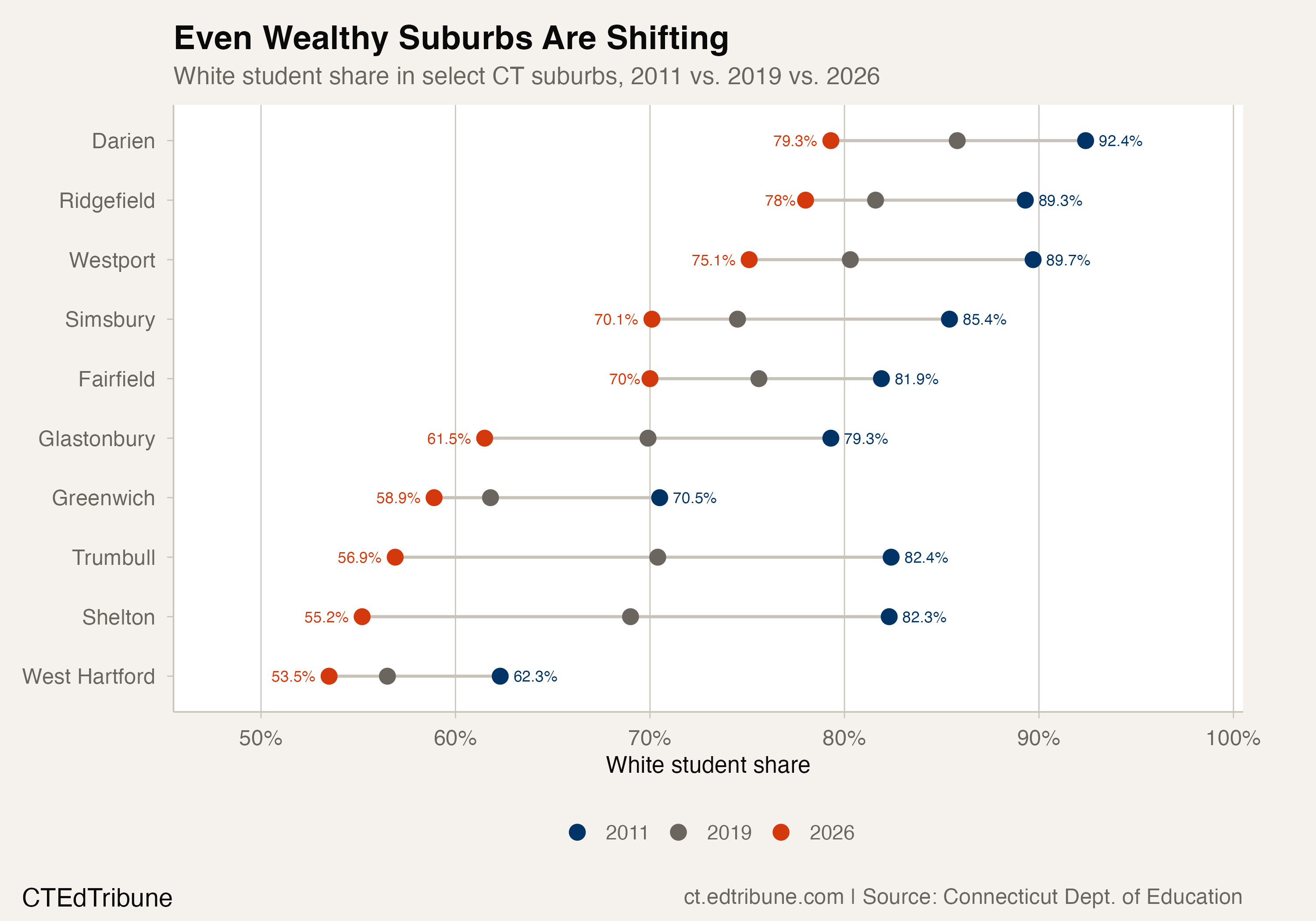
Darien↗ET, one of the wealthiest towns in the country, went from 92.4% white in 2011 to 79.3% in 2026. Westport↗ET fell from 89.7% to 75.1%. Trumbull↗ET dropped from 82.4% to 56.9%, a 25.5-point decline. Shelton↗ET went from 82.3% to 55.2%, now barely above the majority threshold.
West Hartford↗ET, often cited as one of the state's most diverse suburbs, has dropped from 62.3% to 53.5% white. It could join the majority-minority column within the next few years.
These suburban shifts reflect growing diversity in the broader housing market, as Hispanic and Asian families have moved into towns that were once overwhelmingly white. The change is gradual and the starting shares were so high that most wealthy suburbs remain majority-white. But the direction is uniform: every suburb in the sample lost white share in both the pre- and post-pandemic periods.
Diversity Without Integration
The statewide numbers suggest a state becoming more diverse. The district-level numbers tell a more complicated story. Connecticut's demographic shift has not produced integrated schools. According to the School+State Finance Project, a majority of the state's students of color are concentrated in fewer than 15 districts, and more than 45% of these students attend districts where the student body is over 75% students of color.
This is the paradox at the heart of the Sheff v. O'Neill desegregation case, which the Connecticut Supreme Court decided in 1996. Nearly 30 years later, the state has met 96% of its first benchmark goal for placing Hartford students in magnet schools and interdistrict choice programs. But critics argue the remedy has come at a cost to the schools left behind.
"Every time we place a child in another magnet school the money follows the child and Hartford gets that much less." -- Carol Gale, Hartford Federation of Teachers President, Hartford Courant, December 2025
The School+State Finance Project estimates a $639 million racial funding gap in Connecticut's education finance system, with districts serving higher concentrations of students of color spending less per student than whiter, wealthier districts.
What Comes Next
The question is no longer whether Connecticut's public schools will be majority-minority. They already are, and have been since 2020. The question is how fast the composition continues to shift and whether the state's school funding and desegregation frameworks can keep pace.
If Hispanic enrollment growth decelerates, as the 2026 dip may suggest, and white losses continue at their current pace of 6,000 to 8,000 per year, the share lines will still converge. But the crossover date, when Hispanic students become the plurality, depends on whether the 2026 dip was noise or signal. The enrollment data for 2027 will answer that. In the meantime, every suburban district in the state is watching its own share lines move in the same direction, just from further back in the timeline.
Detailed code that reproduces the analysis and figures in this article is available exclusively to EdTribune subscribers.
Discussion
Sign in to join the discussion.
Loading comments...