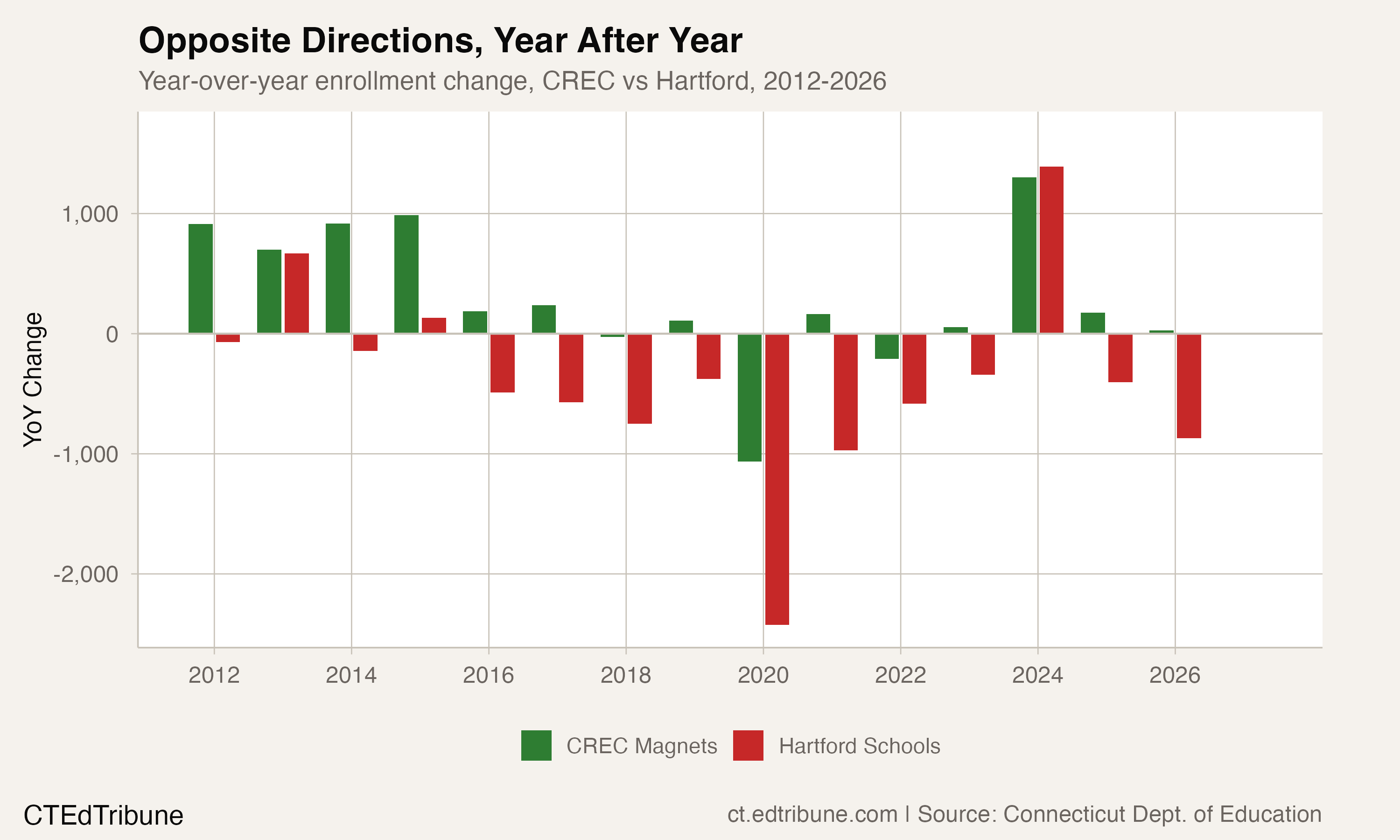
Correction (July 26, 2026): The COVID-era figures in this article came from Connecticut's TOTAL enrollment row before it was reconciled to the EdSight October enrollment census, which undercounted 2020 through 2023 by 16,000 to 19,500 students statewide. Three figures were wrong: CREC did not drop 1,066 students in 2020 (it slipped 15 and then grew), Hartford lost 887 rather than 2,423, and Hartford's 2024 change was an increase of 65 students, not 1,391. The paragraph describing COVID as hitting both entities has been rewritten, because the reconciled data shows it did not. The article's central comparison, CREC's 96% growth against Hartford's 27.2% decline, was not affected.
In 2011, Hartford↗ET enrolled 21,365 students, more than any other district in Connecticut. The Capitol Region Education Council↗ET, which operates interdistrict magnet schools across the Hartford area under a landmark desegregation ruling, enrolled 4,646. Fifteen years later, Hartford has fallen to fourth place with 15,563 students, a 27.2% decline. CREC has nearly doubled to 9,118, now the 10th-largest entity in the state.
The two trajectories are not coincidental. Both flow from a single 1996 Connecticut Supreme Court decision.
A Ruling That Rerouted a Region
The Sheff v. O'Neill case, decided in 1996, found that racial and economic isolation in Hartford's public schools violated the state constitution. Connecticut's response was not to redraw district lines or mandate busing. Instead, the state built a parallel system: interdistrict magnet schools, operated primarily by CREC, designed to draw suburban and city students into shared classrooms voluntarily.
The strategy worked on its own terms. CREC grew from 4,646 students to 9,118 between 2011 and 2026, a 96.3% increase of 4,472 students. It is by far the largest enrollment gainer in the state over that period. The next-closest gainer, Danbury↗ET, added 756.
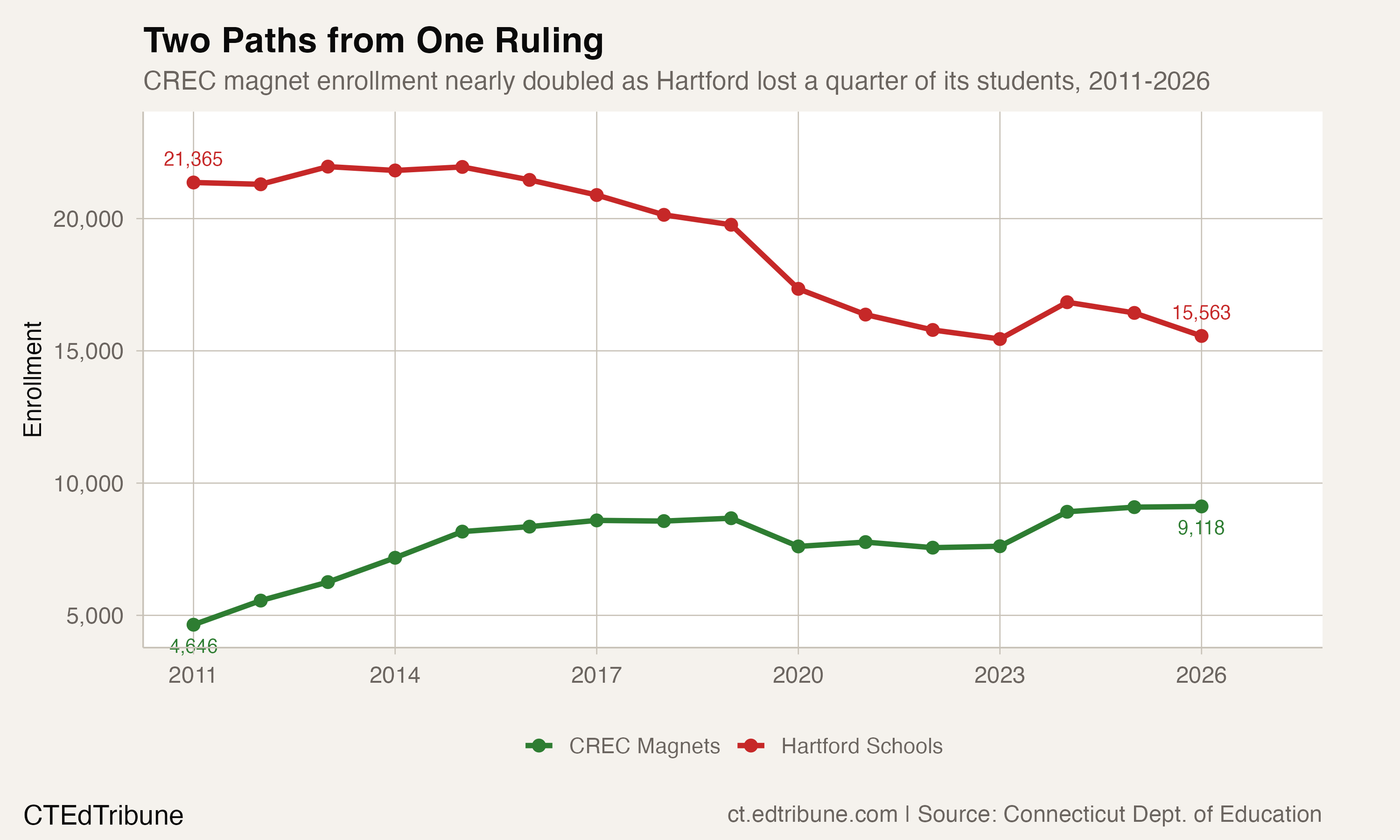
The growth was front-loaded. CREC added roughly 900 students per year from 2011 through 2015, building out elementary grades that barely existed at the start of the decade. Elementary enrollment (grades 1-5) went from 944 to 2,969, a more than threefold expansion. Pre-K doubled from 507 to 1,066.
Then the pace slowed. From 2016 to 2019, CREC gained an average of 127 per year. COVID separated the two entities rather than hitting both. Hartford lost 887 students in 2020 and another 1,147 in 2021, while CREC slipped by 15 and then grew by 142. Hartford's decline paused for a single year in 2024, adding 65 students, then resumed with losses of 405 and 871. CREC kept climbing, reaching a new peak of 9,118 in 2026.
The Arithmetic of Desegregation
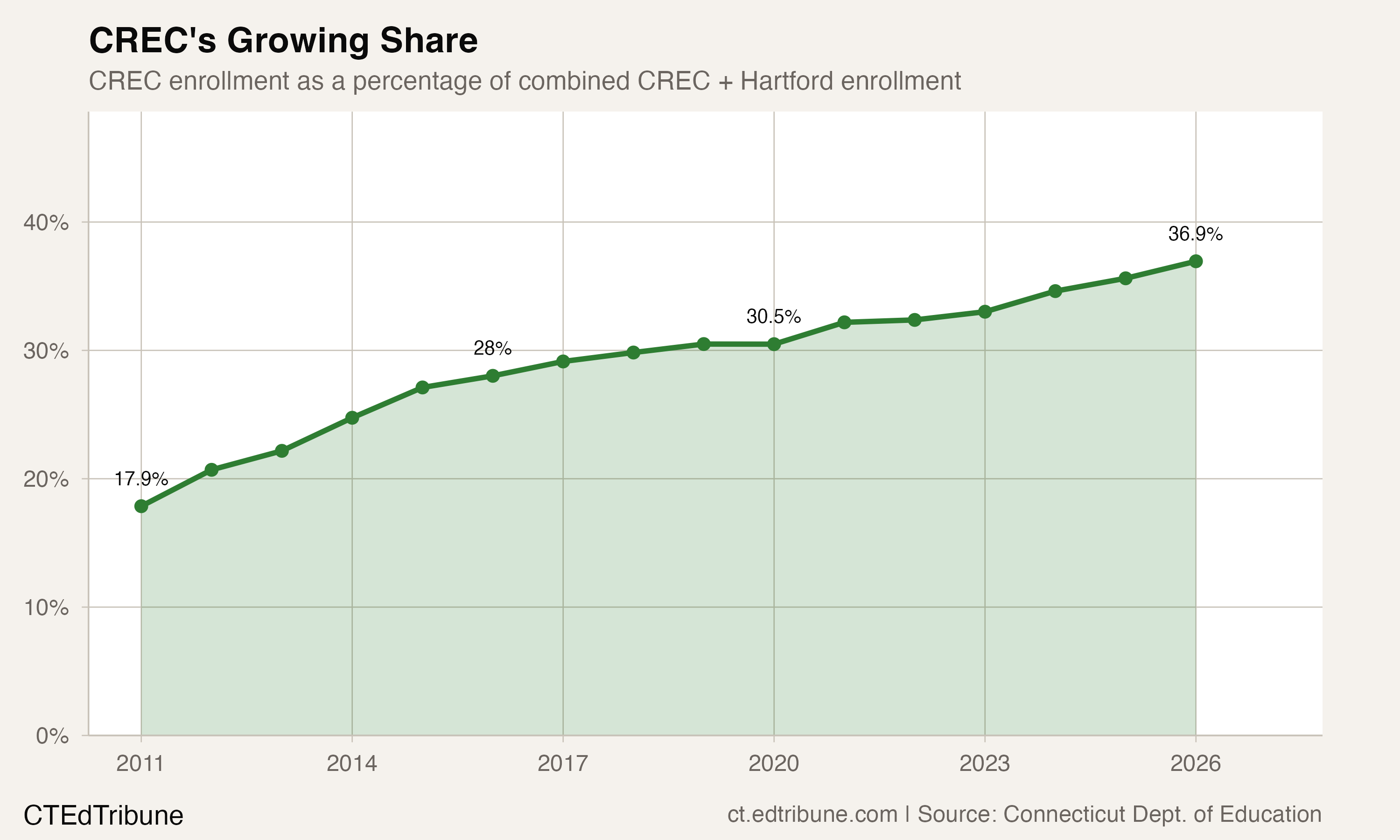
CREC's gain of 4,472 students equals 77.1% of Hartford's loss of 5,802. That ratio does not mean CREC literally siphoned those students from Hartford classrooms. Hartford-resident students who attend CREC magnets are counted under CREC, not Hartford, so the shift in where students are counted is part of the enrollment story by design. The combined CREC-plus-Hartford enrollment fell from 26,011 to 24,681 over the period, a net loss of 1,330 students. Regional population decline accounts for some of the shrinkage. But the redistribution is the dominant force: CREC's share of the combined total rose from 17.9% in 2011 to 36.9% in 2026.
Half of Hartford's school-age residents now attend schools outside the traditional district, a figure that has grown steadily since the Sheff settlement expanded choice seats. The state met 96% of entry-grade demand for Hartford families seeking magnet or Open Choice placements in the most recent reporting year, progressing toward 100% by 2028-29.
The Funding Follows the Student
Every student who leaves Hartford for a CREC magnet takes per-pupil funding with them. Hartford now faces a $30 million budget deficit and is maintaining buildings constructed for twice their current enrollment. The district has mitigated nearly $144 million in budget reductions over the past 11 years, eliminating 644 positions.
"Hartford's school funding dollars should support students, not empty buildings, or inefficient back-office services." — Mayor Arunan Arulampalam, October 2025
The fiscal squeeze runs in both directions. A 2025 state analysis found that Hartford is underfunding its own magnet schools relative to neighborhood schools. In 2019, magnets received roughly $650 less per pupil than neighborhood schools. By 2024, that gap had widened to $3,300. The state education department cited the district for the disparity, arguing that high-quality magnets are essential to the Sheff settlement's success.
Hartford hired Caissa K12, an enrollment recruitment firm, under a contract capped at $500,000 and pegged to $935 per student recruited. The goal: bring back some of the 9,000-plus students who have left through choice programs. That a public school district is paying a private contractor to recruit students back from a publicly funded magnet system built to serve the same students captures the circular logic of the current arrangement.
A Magnet System That Looks Like Hartford
One premise of Sheff was integration. CREC's demographic profile suggests the magnets have become less a bridge between city and suburb and more an extension of Hartford's own composition. In 2011, CREC's student body was roughly a third white (32.0%), a third Black (33.1%), and a quarter Hispanic (26.8%). By 2026, Hispanic students make up 44.6%, Black students 31.9%, and white students just 13.3%.
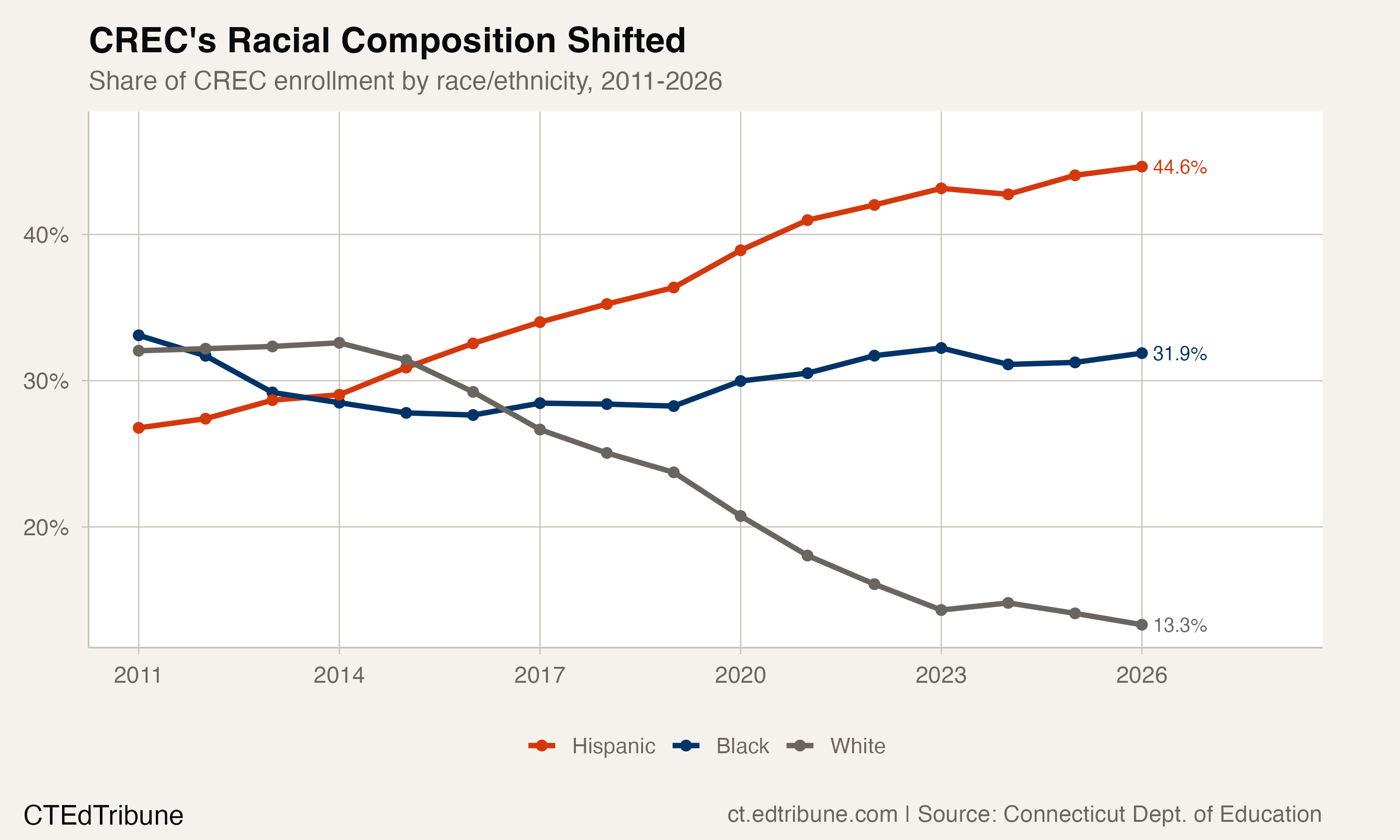
Hartford itself was already 92% students of color in 2011 (52.2% Hispanic, 34.5% Black, 8.1% white). By 2026, white enrollment fell to 5.6%. The question is whether CREC's demographic trajectory represents the magnets drawing fewer suburban white families or reflects the broader statewide decline in white enrollment (down 35.8% since 2011 across Connecticut). The data cannot distinguish between the two, though both are likely contributing.
"This is a measure of success for the CSDE in its pursuit of being released from court oversight, not a significant indicator of breaking down the longstanding racial disparities." — Hartford BOE Chairperson Shonta Browdy, December 2025
The Rest of the Region
Hartford is not the only district in the Capitol Region losing students. Every surrounding suburb except South Windsor↗ET shrank between 2011 and 2026. Bloomfield↗ET lost 19.8%. Glastonbury↗ET lost 17.7%. West Hartford↗ET, the region's second-largest traditional district, lost 11.7%. Even Farmington↗ET, essentially flat, dipped 1.4%.
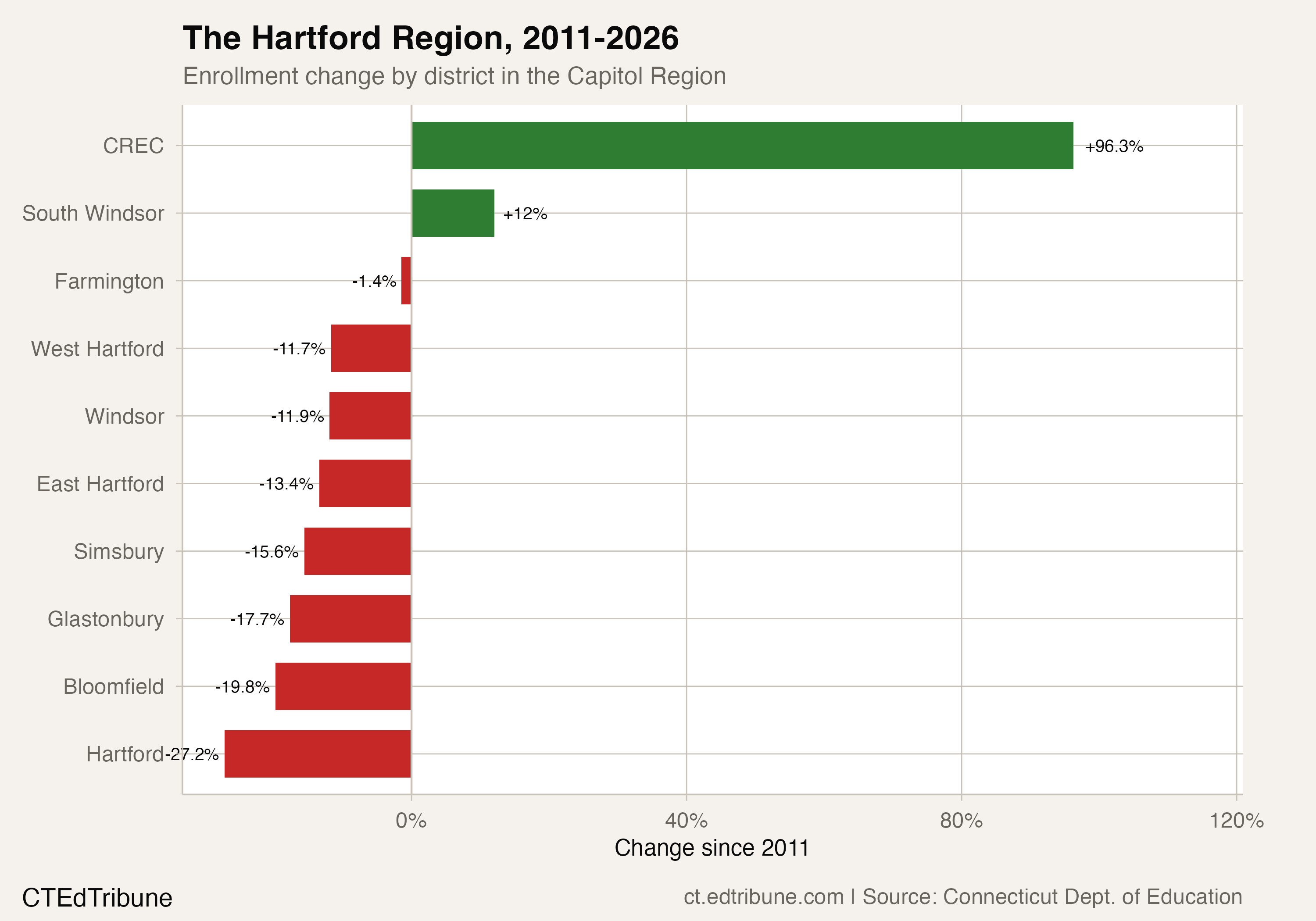
CREC's 96.3% growth dwarfs everything else on the chart. South Windsor, the only traditional district to grow meaningfully, added 554 students (12.0%). The regional picture suggests CREC is not simply replacing Hartford. It is becoming the dominant new institution in a region where traditional districts of every type are contracting.
What Comes Next
The Sheff settlement's next milestone is 100% demand satisfaction by 2028-29. If achieved, every Hartford family that wants a magnet or Open Choice seat will get one. That would likely accelerate the enrollment transfer that is already hollowing out Hartford's traditional schools.
Hartford faces a choice that no recruitment firm can resolve. It can compete for students by investing in neighborhood school quality, or it can consolidate around a smaller footprint and redirect resources to fewer, stronger programs. The mayor's "Centers of Excellence" proposal points toward consolidation. But closing schools in neighborhoods that have already lost population carries its own political and human costs.
CREC, for its part, has reached a scale where its continued growth is no longer guaranteed. Its enrollment has plateaued near 9,100 for three years. The magnet system now enrolls more students than all but nine traditional districts in the state. Whether it keeps growing depends on whether suburban families continue to opt in, and on whether Hartford's remaining enrollment has anywhere left to fall.
Detailed code that reproduces the analysis and figures in this article is available exclusively to EdTribune subscribers.
Discussion
Sign in to join the discussion.
Loading comments...