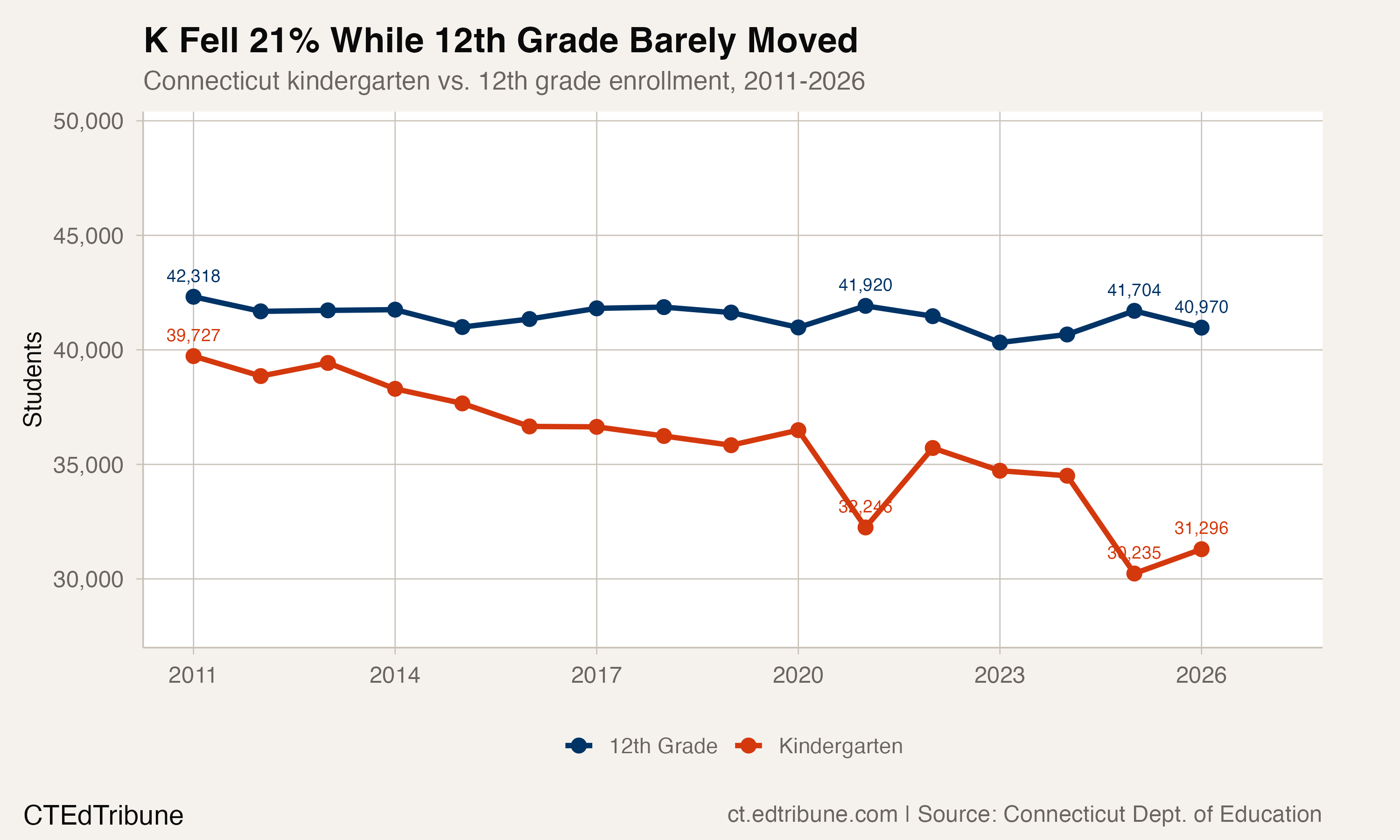
Connecticut's 12th graders outnumber its kindergartners by nearly 10,000 students. In 2010-11, the two grades were roughly the same size. Fifteen years later, for every 100 seniors graduating out the top of the system, only 76 kindergartners are entering at the bottom.
That ratio, 76.4 kindergartners per 100 12th graders, captures the core structural problem facing Connecticut's public schools. Total enrollment has fallen 11.8% since 2010-11, from 564,499 to 497,760. But the decline is not distributed evenly across grade levels. It is concentrated at the bottom of the pipeline, where the losses are roughly twice as severe as at the top, and where they guarantee years of further decline regardless of what happens next.
The grades that shrank most
Kindergarten lost 8,431 students between 2010-11 and 2025-26, a 21.2% decline from 39,727 to 31,296. First grade fared worse: down 10,225 students, a 25.0% drop from 40,860 to 30,635. These are the two smallest non-PK grades in the state.
Twelfth grade, by contrast, lost just 1,348 students over the same span, a 3.2% decline. The gap between K-5 and 9-12 is stark: elementary grades (K through 5) have shed 39,378 students, a 16.1% decline. High school grades (9 through 12) lost 16,319, or 9.3%.
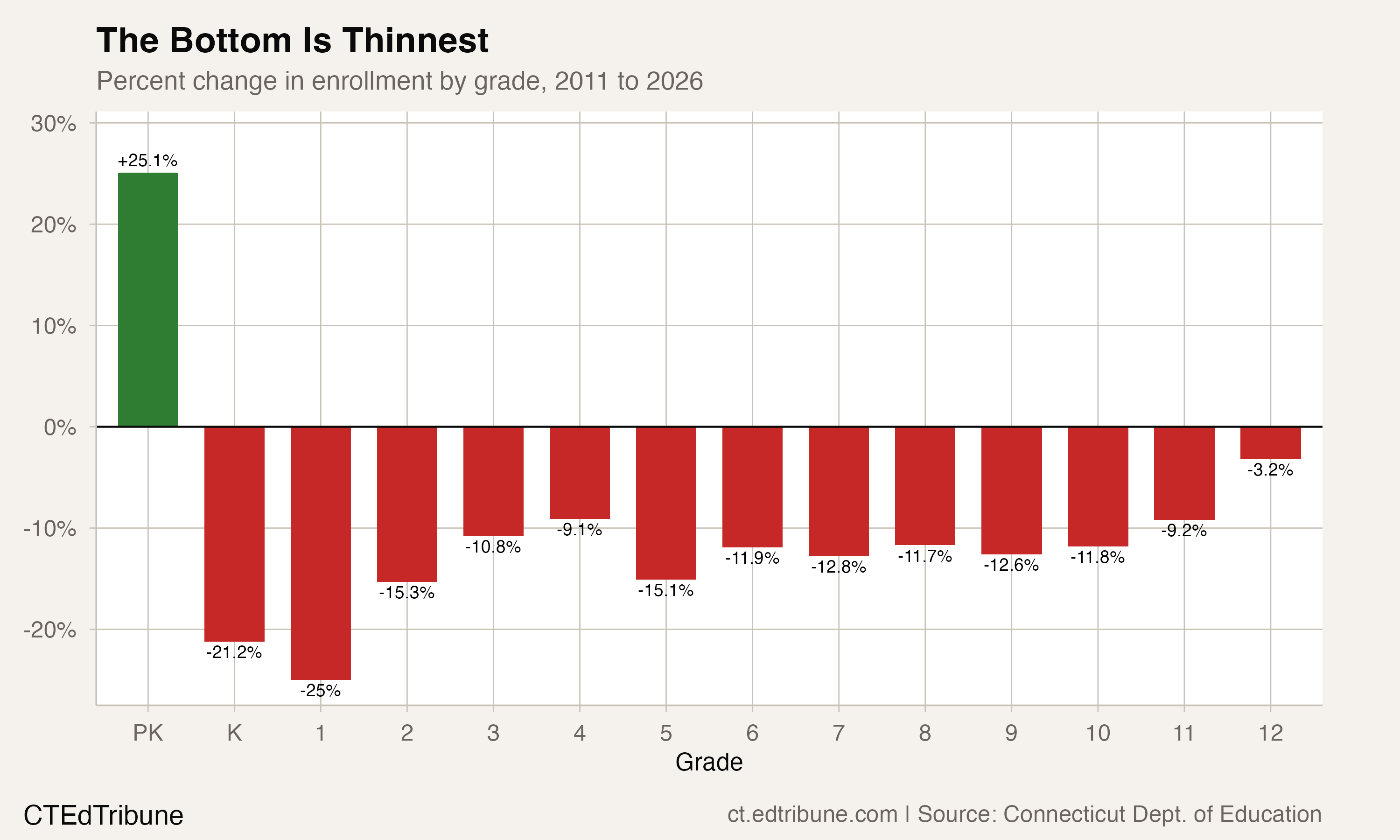
Pre-K stands alone as the only grade level that grew, rising 25.1% from 16,425 to 20,540 students. Connecticut's Early Childhood Education Endowment, established in 2025 and expanded in the FY2027 budget, is intended to add child-care and preschool capacity. But pre-K expansion does not reverse the kindergarten decline. It means more children are entering the public system earlier, then continuing into a kindergarten class that keeps getting smaller.
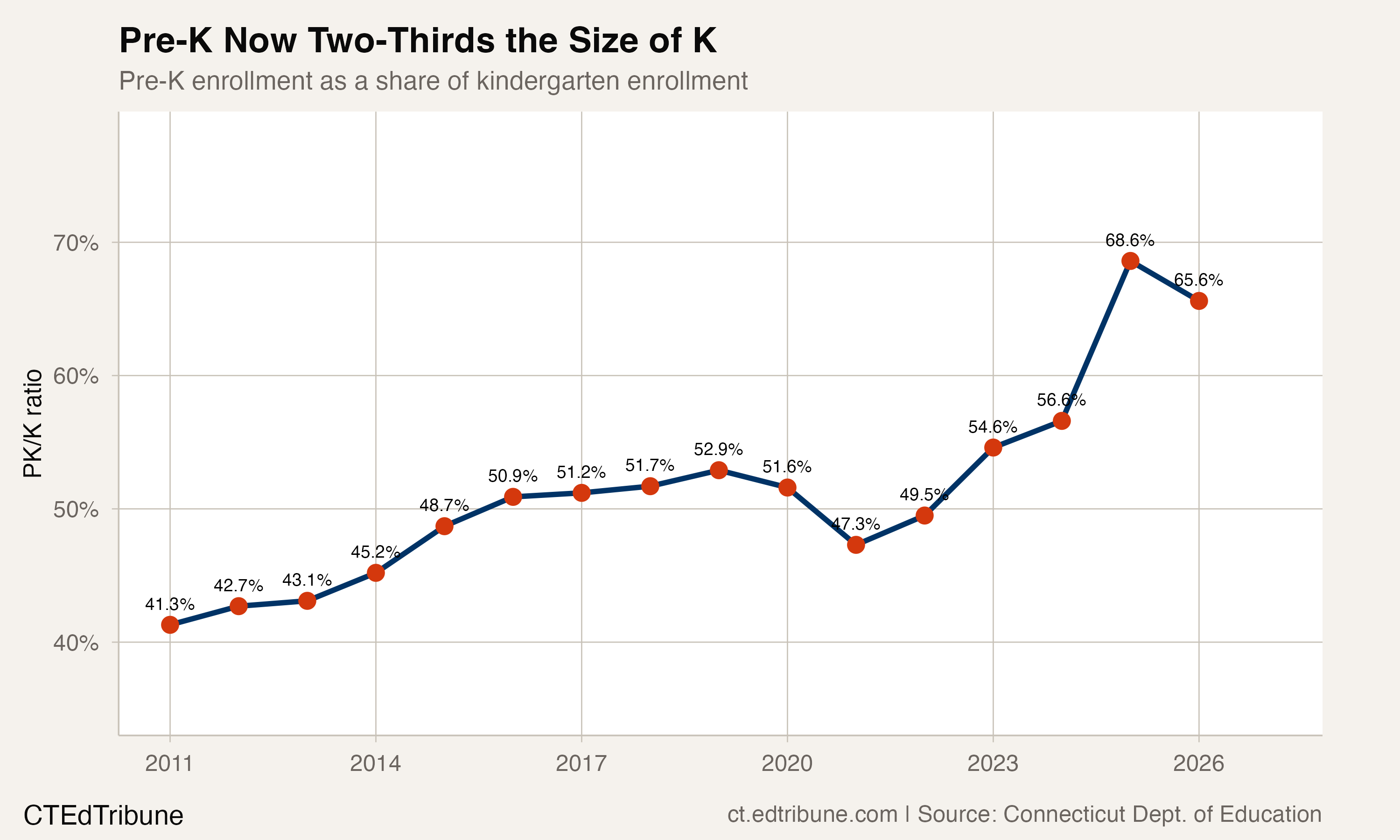
The pre-K to kindergarten ratio tells this story. In 2010-11, pre-K enrollment equaled 41.3% of kindergarten. By 2025-26, it reached 65.6%. Pre-K has not grown because kindergarten shrank. Both trends are real and independent. But they produce a system where the on-ramp is expanding while the first lane is narrowing.
Two crashes in five years
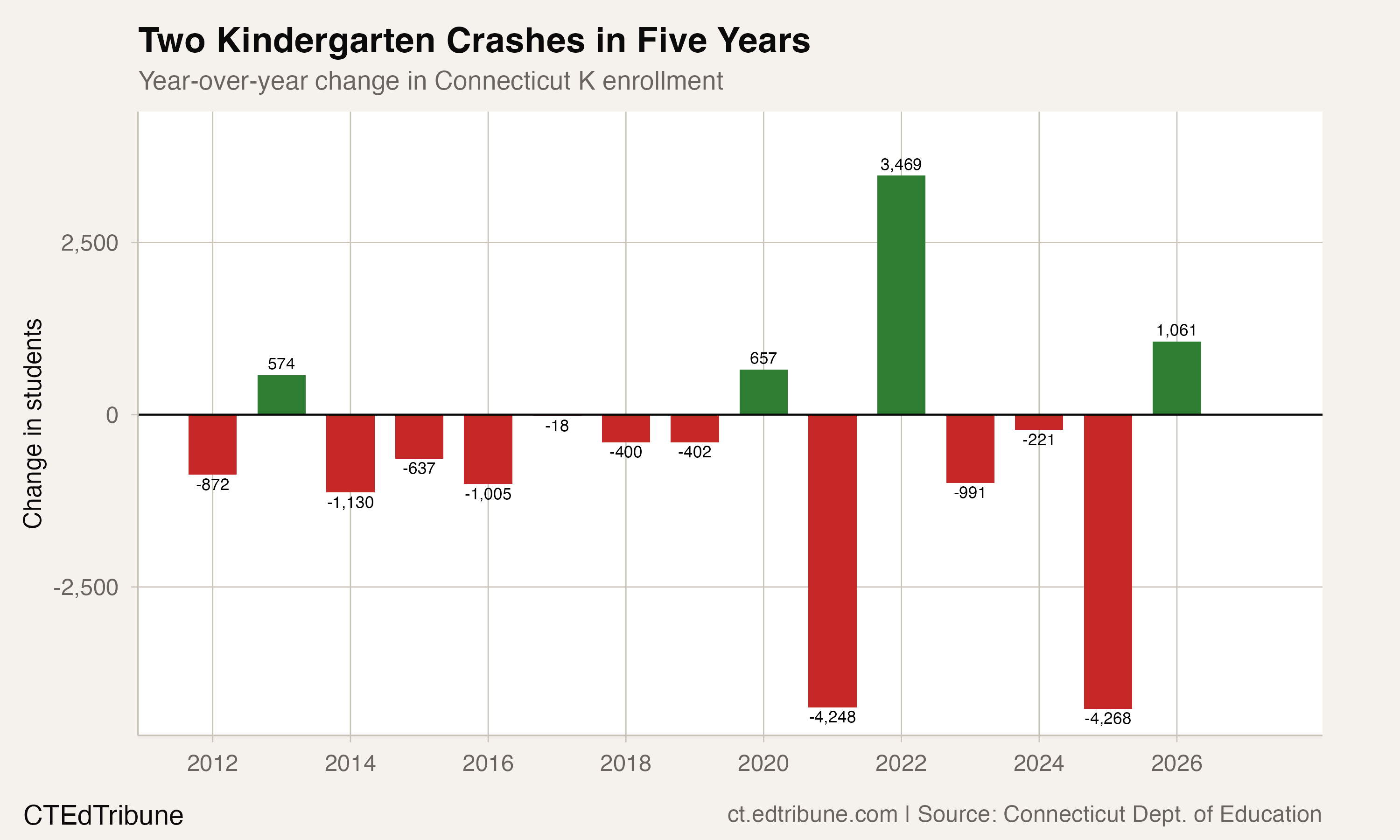
The year-over-year pattern reveals two distinct kindergarten crashes layered on top of a longer decline.
The first came in 2020-21, when COVID-19 drove kindergarten enrollment down 4,248 students in a single year, an 11.6% drop. Connecticut law does not require school attendance until age 7, and many families held children out. The rebound came the following year: kindergarten surged by 3,469 in 2021-22 as delayed entrants arrived alongside the regular cohort.
The second crash came in 2024-25, when kindergarten fell 4,268 students, a 12.4% drop. This was not a pandemic. It was a policy change. Connecticut shifted its kindergarten age cutoff from January 1 to September 1, effective fall 2024. Children born between September and December 2019, who would have been eligible under the old rule, were not automatically eligible under the new one. The state estimated roughly 9,000 students would be affected, though families could apply for waivers.
The 2025-26 data shows a partial rebound of 1,061 students, bringing kindergarten to 31,296. That is consistent with the expected one-time nature of the cutoff effect: the children bumped from the 2024-25 class entered in 2025-26, but a new, smaller steady state has been established.
Why the pipeline keeps thinning
The age cutoff change produced a visible one-year shock, but the longer decline predates it by a decade. Kindergarten fell in 11 of the 15 year-over-year transitions between 2011 and 2026. The four years it rose (2012-13, 2019-20, 2021-22, and 2025-26) were all rebounds from prior drops, not new growth.
The most likely structural driver is Connecticut's shrinking birth cohorts. The state's fertility rate stood at 50.7 per 1,000 women of childbearing age in 2022, tracking a national decline. Fewer births five years earlier mean fewer kindergartners in the 2025-26 data. Connecticut was shrinking faster than 48 other states in school-age population as early as 2017, and the underlying demographic pressure has not eased.
A contributing factor is the expansion of alternatives. Connecticut does not track homeschool enrollment comprehensively, but the state saw a surge in families choosing home education during COVID. Andrea Brinnel, an early childhood specialist with the Connecticut Department of Education, told Connecticut Public that pandemic-era children "didn't get the chance to practice some of those skills" and were "showing up looking a little different in kindergarten than they did a couple years ago." That observation, from 2022, predates the age cutoff change and points to a longer disruption in how families approach early schooling.
Where the losses are concentrated
Kindergarten did not shrink everywhere equally. Of the 104 districts with at least 100 kindergartners in 2010-11, 88 lost enrollment by 2025-26. Only 16 gained.
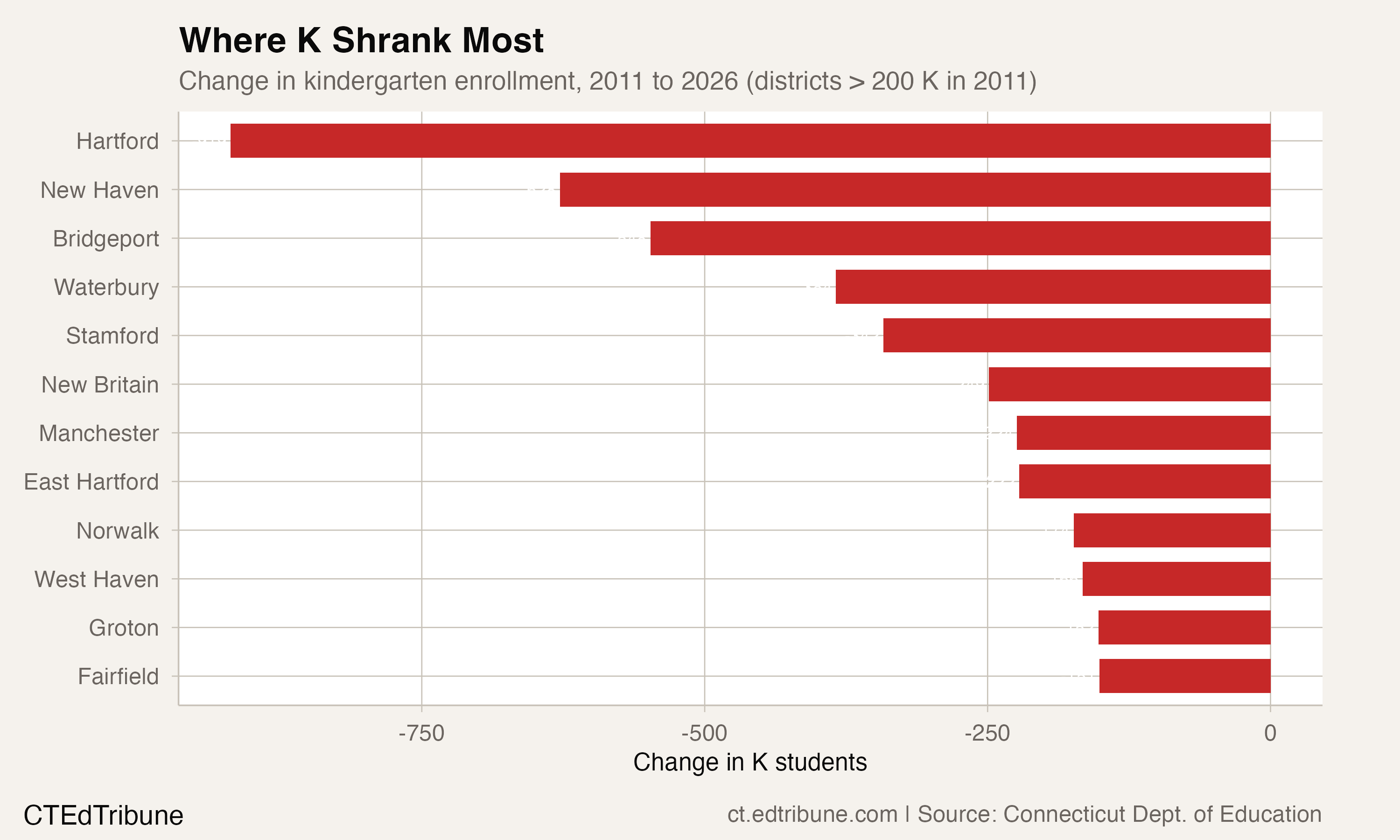
Hartford↗ET absorbed the largest absolute loss: 919 fewer kindergartners, a 50.6% decline from 1,818 to 899. New Haven↗ET lost 628 (down 37.6%). Bridgeport↗ET lost 548 (down 29.0%). These three cities account for 2,095 of the statewide loss of 8,431, or roughly one-quarter.
Smaller cities were hit nearly as hard proportionally. East Hartford↗ET lost 41.9% of its kindergarten class. Manchester lost 36.4%. New Milford lost 45.3%.
The Capitol Region Education Council, which operates interdistrict magnet schools, was the largest gainer: from 282 kindergartners in 2010-11 to 591 in 2025-26, an increase of 309. CREC's growth reflects the expansion of magnet programs under the Sheff v. O'Neill desegregation mandate, which draws students from Hartford and surrounding suburbs into shared schools. But CREC's gains do not offset Hartford's losses. They partly explain them.
What the numbers guarantee
The pipeline math is unforgiving. The 30,635 first graders in 2025-26 will become second graders in 2026-27. The 31,296 kindergartners will become first graders. Cohorts do not grow as they age through the system. They shrink slightly from attrition, or hold roughly steady. The 2010-11 kindergarten class of 39,727 produced a 2022-23 12th grade class of 40,320, a near-perfect flow-through. So 2025-26 kindergarten enrollment is, within a narrow margin, a preview of 12th grade enrollment in 2037-38.
That means Connecticut's total enrollment will continue declining for at least a decade, even if kindergarten stabilizes tomorrow. The 31,296 kindergartners entering in 2025-26 will replace a 12th grade class of 40,970 when they graduate. That is a net loss of nearly 9,700 students from that single cohort's journey through the system.
Connecticut's hold-harmless provision, which has prevented municipalities from losing state education funding despite enrollment declines since FY 2022, shields districts from the immediate fiscal consequences. Without it, the state would face over $200 million in collective funding losses. But the policy does not create students. It creates a growing gap between funding levels designed for a larger system and the smaller one that now exists.
The question is not whether the pipeline will thin the rest of the system. It already has: K-5 enrollment fell 16.1% while 9-12 fell 9.3%. The question is what happens when the 2025-26 kindergarten classes, 21% smaller than their predecessors, reach high school. By then, the 12th grade classes that have barely budged for 15 years will finally start to shrink.
Detailed code that reproduces the analysis and figures in this article is available exclusively to EdTribune subscribers.
Discussion
Sign in to join the discussion.
Loading comments...