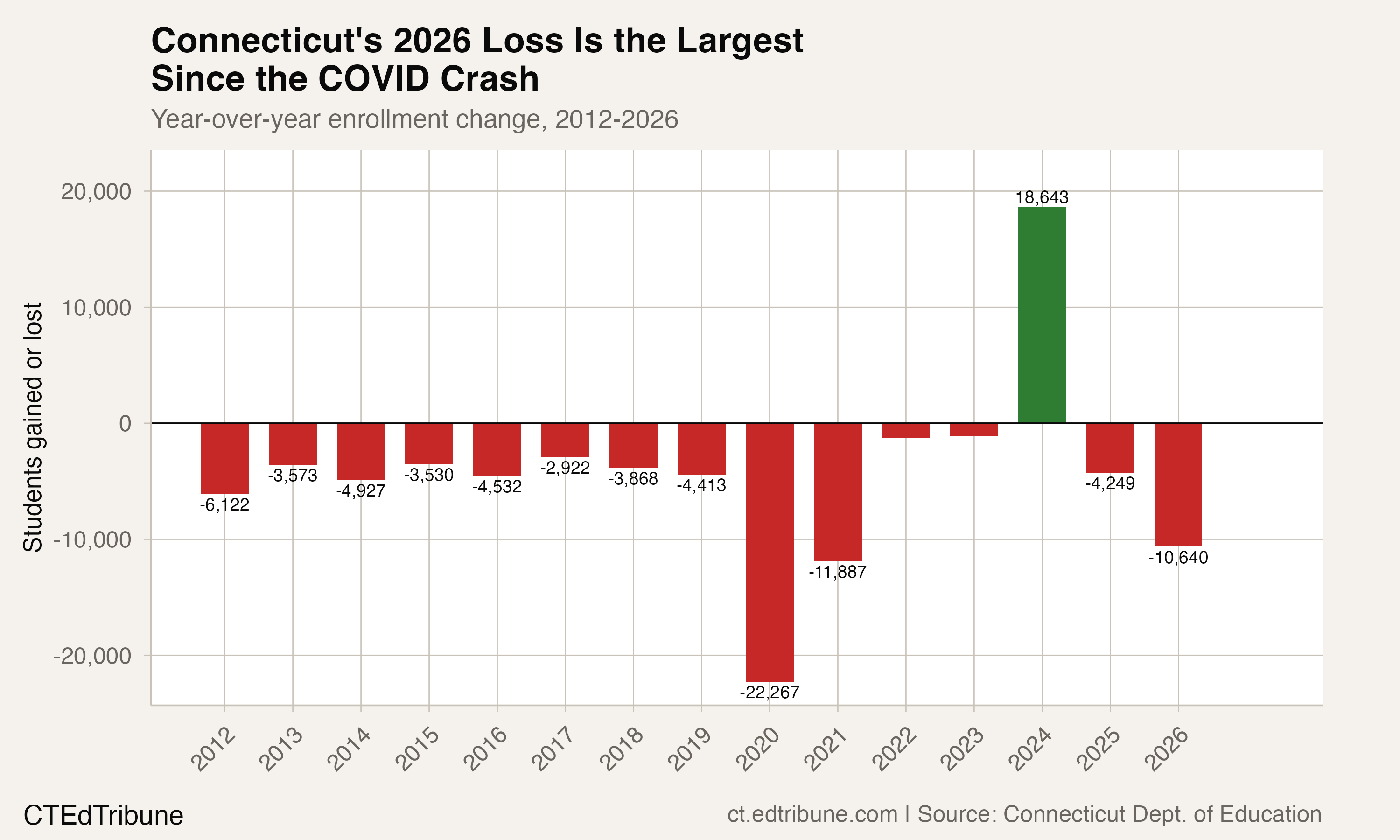
Correction (April 18, 2026): An earlier version of this article described a 2024 enrollment gain of 18,643 students. That figure reflected a reporting artifact in the state's TOTAL enrollment row, not a real gain. References to "494,006" as a 2023 low have also been corrected. See the milestone article correction for full details.
Correction (July 26, 2026): The April correction did not reach the district-level figures, which came from the same unreconciled TOTAL row. In 2024 Hartford added 65 students, not 1,391; New Haven lost 184 rather than gaining 1,190; and Stamford added 181, not 401. Because none of the three was actually rebounding in 2024, the passage describing 2026 as a reversal of a 2024 influx has been rewritten, along with the related line in the introduction and the section heading above the trend chart. The statewide figures, the first-grade analysis, and the district loss rankings for 2026 were not affected.
After a brief post-COVID plateau, where enrollment barely moved from 2022 through 2024 (changes of +536, -102, and -862), the decline returned with force. Connecticut lost 10,640 students in 2025-26, a 2.1% decline that marks the largest single-year enrollment drop outside of COVID since at least 2007. The loss accelerated sharply from the prior year's decline of 4,249, leaving the state at 497,760 students.
The anatomy of the 2026 drop reveals something more specific than a generic "declining enrollment" story. One grade, first grade, accounts for 41% of the entire statewide loss. Five districts account for more than a third of it. And Connecticut's one demographic bright spot of the past decade, growth in multilingual learners, reversed for the first time.
The first grade crater
The statewide picture obscures how concentrated the 2026 loss is by grade level. Of 14 grades tracked (pre-K through 12th), first grade alone shed 4,322 students, a 12.4% collapse in a single year. No other grade lost more than 1,686.
The arithmetic explains most of the plunge. In 2024-25, kindergarten enrollment dropped to 30,235, the lowest figure in the 16-year dataset. When that cohort moved into first grade in fall 2025, it replaced a substantially larger class that had entered first grade the previous year. The result: first grade fell from 34,957 to 30,635, a drop so steep it accounts for more than four of every ten students the state lost.
The 2024-25 kindergarten dip itself has a specific cause. Connecticut moved its kindergarten entry cutoff from January 1 to September 1 starting that year, under Public Act 23-208. Children with fall birthdays who would have entered kindergarten under the old rule were held back, creating a one-time compression in the kindergarten class that is now rippling into first grade. The 2026 kindergarten rebound of 1,061 students is consistent with a partial normalization after that policy-driven dip.
Two grades bucked the trend. Kindergarten rebounded by 1,061 students to 31,296, and fourth grade added 2,019 students. The kindergarten bounce offers some relief, but it merely returns the grade to roughly where it stood in 2023, well below the 36,000+ range that was standard before COVID.
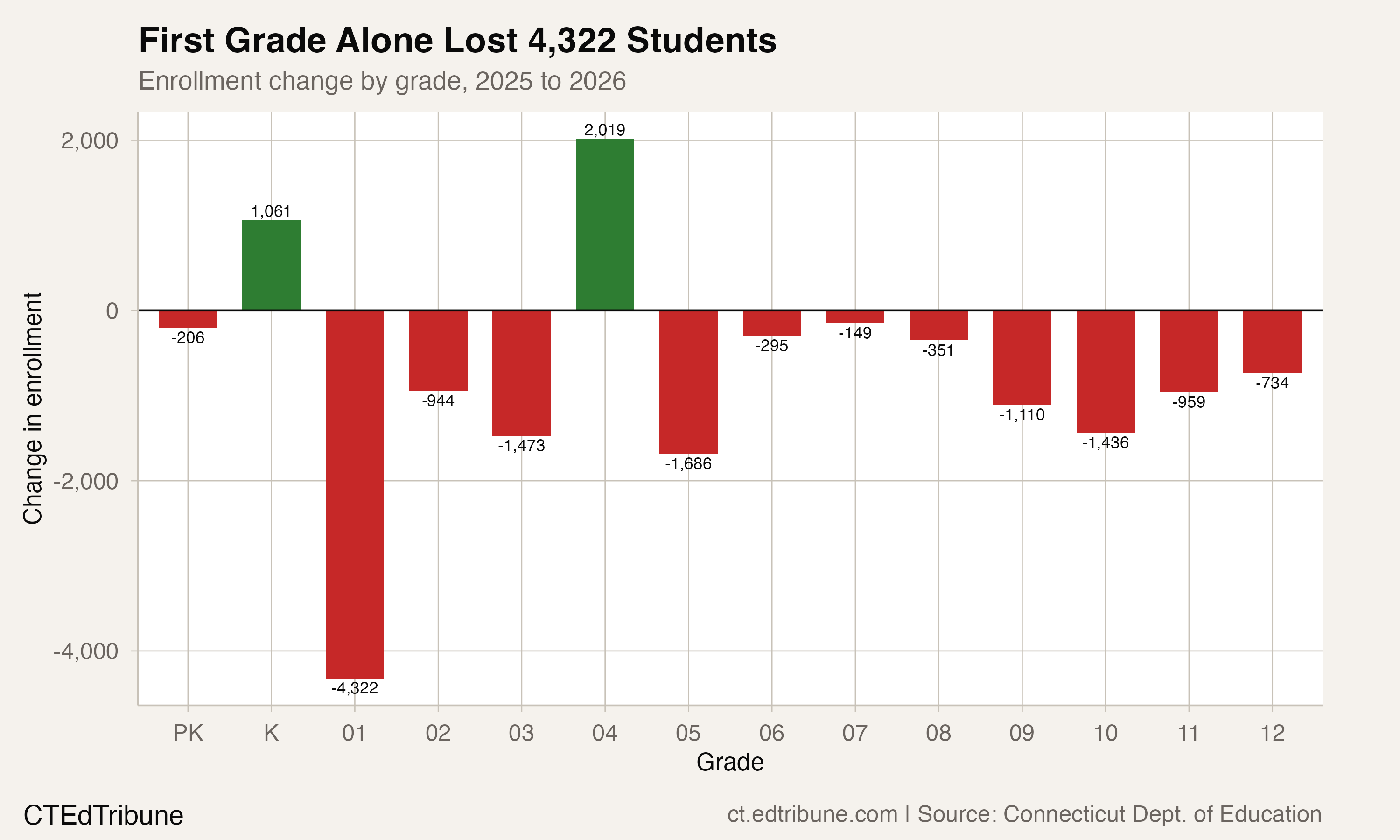
The pipeline math carries a warning for the years ahead. High school grades (9-12) collectively lost 4,239 students in 2026, as smaller cohorts from the early-2020s elementary contraction begin reaching the upper grades. That pressure will intensify: the kindergarten classes entering the pipeline now are 21% smaller than they were in 2011.
Five cities, half the damage
Three-quarters of Connecticut's districts, 149 of 199, lost students in 2025-26. But the losses concentrate heavily in the state's cities.
New Haven↗ET led with 980 fewer students, a 5.2% decline that dropped the district to 17,837. Hartford↗ET lost 871 (5.3%), falling to 15,563 amid a $45 million budget deficit that has forced the district to consider school closures. Stamford↗ET shed 843 students (5.2%), Bridgeport↗ET lost 642 (3.2%), and Danbury↗ET dropped 506 (4.2%).
Those five districts alone account for 3,842 of the state's 10,640-student loss, or 36%. Expand to the top 10 losers, which includes Waterbury, East Hartford, Meriden, Manchester, and Groton, and the figure reaches 5,294, or 45.6% of the total decline.
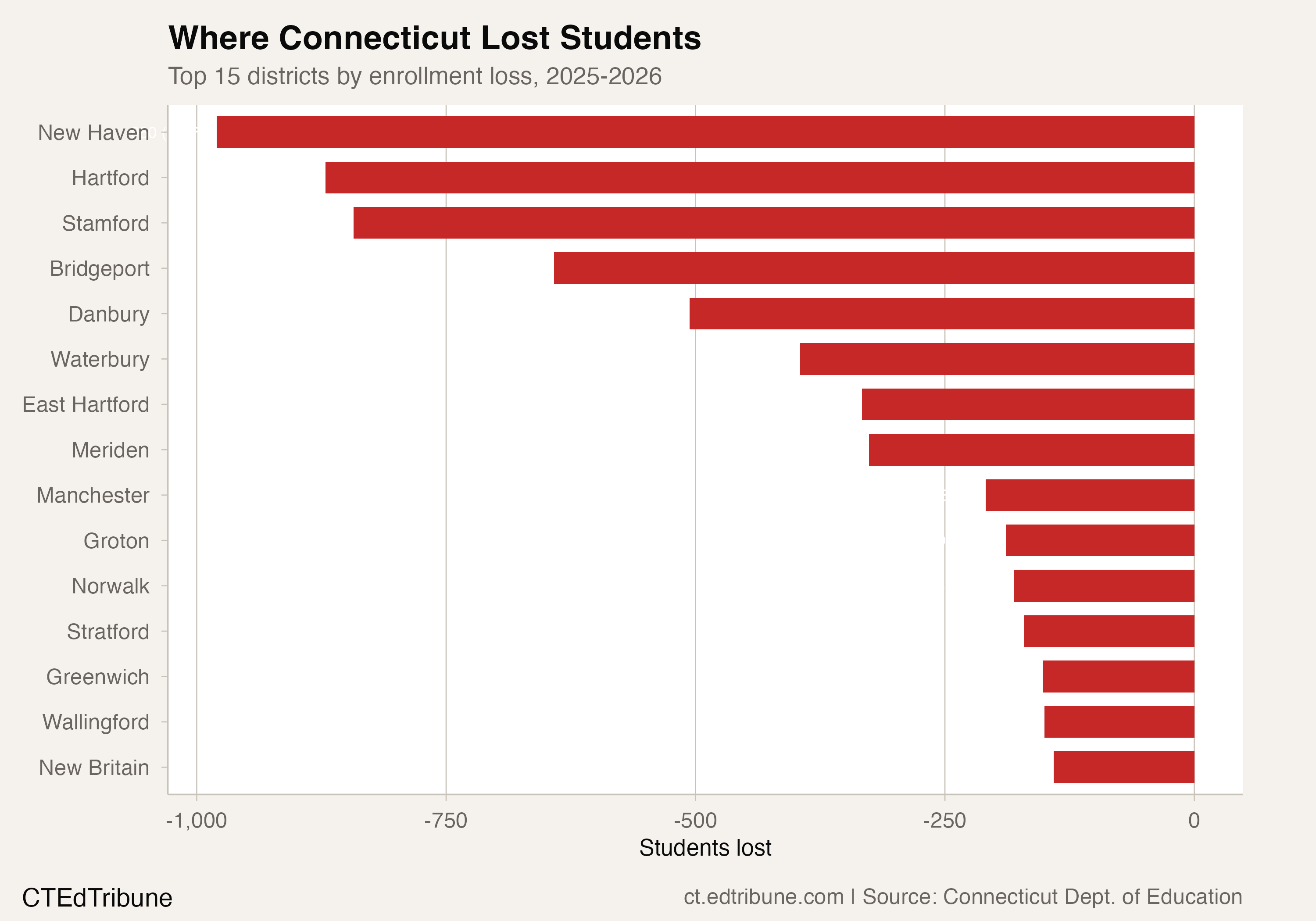
None of these districts was growing before the drop. Hartford added 65 students in 2024 and has since lost 871. New Haven lost 184 in 2024 and another 980 in 2026. Stamford added 181 and then shed 843. The 2026 losses did not reverse a recovery in the state's largest districts; they steepened a decline that was already underway.
Only 44 districts grew, and most gains were marginal. The largest gainer, the Connecticut Technical Education and Career System, added 316 students, 2.8% growth that reflects the statewide trend toward career-technical education. No traditional school district gained more than 31 students.
How short the plateau was
The state's 16-year enrollment trajectory shows how brief the post-COVID plateau was. From 2012 to 2020, Connecticut lost students every year. The 2022-2024 plateau offered three years of near-flat enrollment, but the two years since have erased that stability. The state has lost 15,853 students since the 2022 plateau peak of 513,613, falling to 497,760.
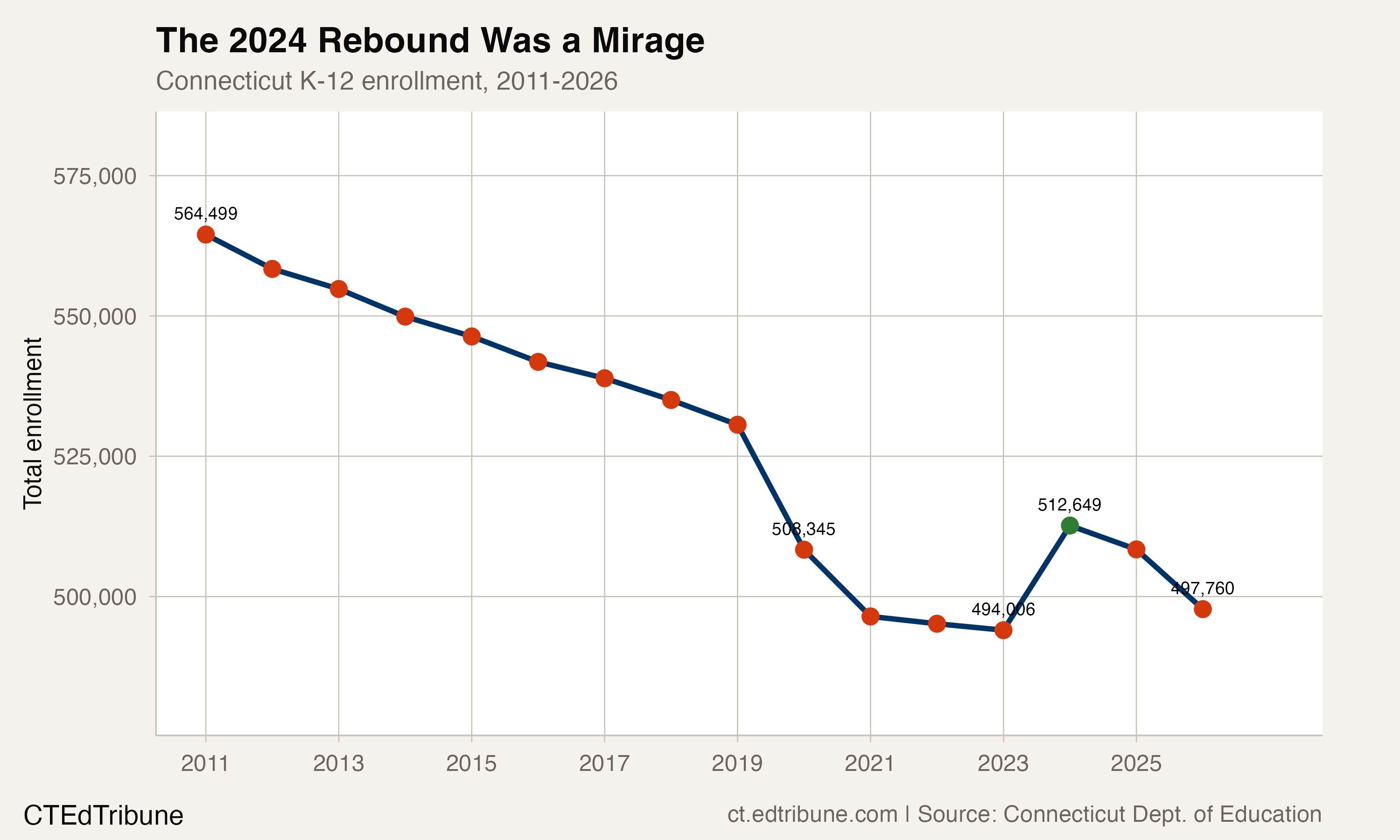
The post-COVID plateau coincided with a change in how the state classified students eligible for free or reduced-price lunch: that subgroup surged from 40.5% to 56.0% of enrollment in 2024, a 15.5 percentage-point jump consistent with a reporting methodology change rather than a genuine shift in family income.
What is clear: the plateau did not hold. The 2025 decline of 4,249 was already larger than the pre-COVID annual average of roughly 4,200 students lost per year. The 2026 figure of 10,640 is 2.5 times that, suggesting the decline is accelerating, not merely returning to its prior pace.
Every racial group lost students except one
The 2026 decline was not confined to a single demographic. White students accounted for the largest share: 6,816 fewer students, or 64% of the total loss, shrinking from 229,388 to 222,572. Black enrollment fell by 2,532, Hispanic by 1,592, and Asian by 611. Only multiracial students gained, adding 631.
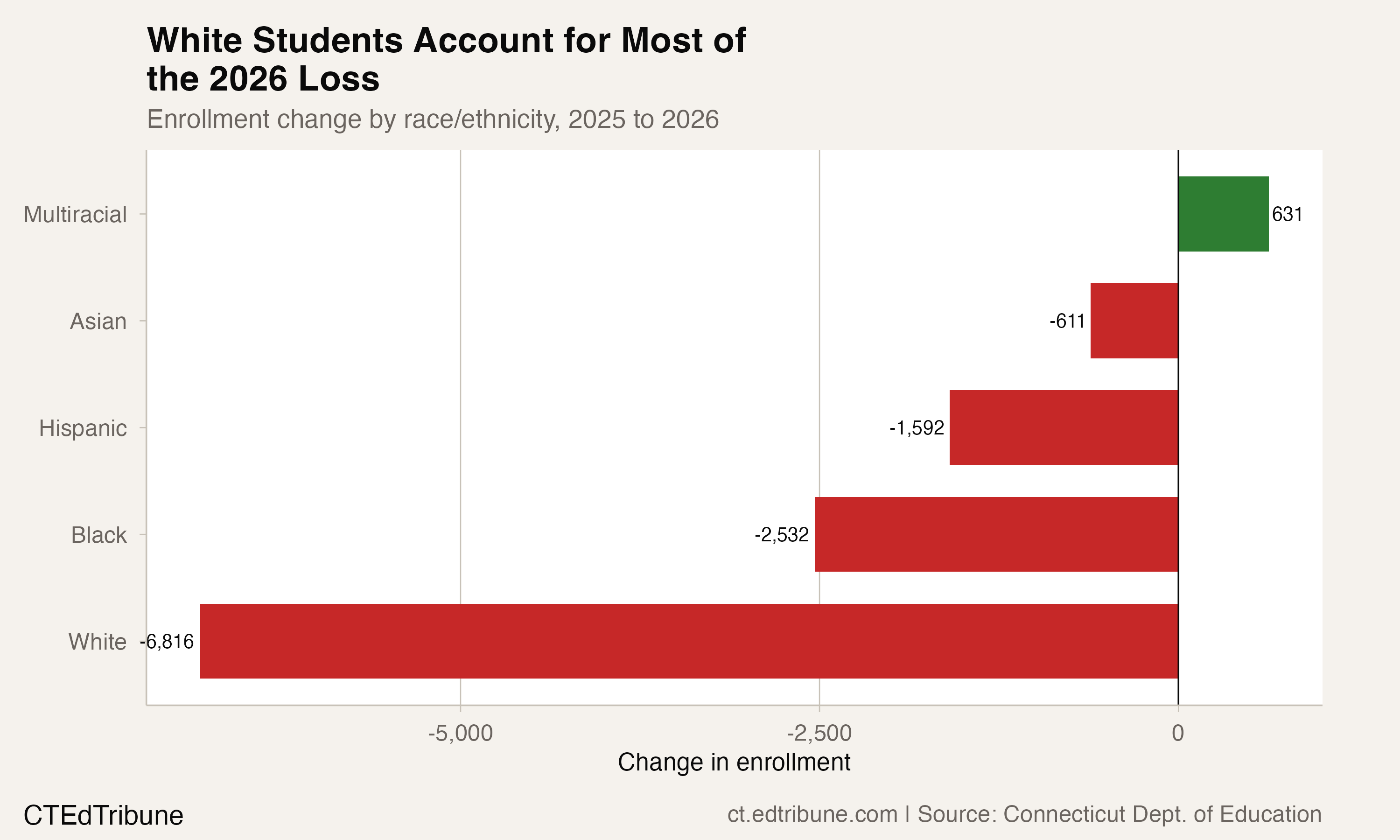
The Hispanic decline is notable because this group had been the only major racial category consistently adding students to Connecticut schools. Hispanic enrollment grew 50.2% since 2011, from 107,617 to 161,618. The 2026 loss of 1,592, a 1.0% dip, is modest in percentage terms but marks an inflection in what had been the state's most reliable source of enrollment stability.
The multilingual learner reversal
Separately from race, the decline in English learners stands out. Connecticut lost 2,157 ELL students statewide, dropping from 57,447 to 55,290, a 3.8% decline. This was the first year-over-year decrease for this subgroup in over a decade, following years where multilingual learners were one of the few growing populations.
The losses concentrate in cities with large immigrant communities. Hartford lost 388 ELL students (9.0% of its ELL population), New Haven lost 338, Danbury lost 309, Bridgeport lost 295, and Stamford lost 213. Those five districts alone account for 1,543 of the 2,157 statewide ELL loss.
"For the first time in over a decade, the number of English language learners enrolled in Connecticut public schools fell." — CT Mirror, December 10, 2025
The timing coincides with the Trump administration's January 2025 reversal of federal guidance that had prevented immigration enforcement in schools since 2014. Advocates have attributed the drop to families keeping children home or leaving districts out of fear of ICE activity. In New Haven, where about 340 fewer multilingual learners enrolled, teachers testified to legislators that students stopped attending after parents were detained.
Whether the ELL decline reflects families leaving Connecticut, children being kept home while still residing in-state, or a combination remains unknown. The state does not track enrollment by immigration status, so the data can show the result but not the mechanism.
The fiscal cushion, and its limits
Connecticut's "hold harmless" provision in the Education Cost Sharing formula currently prevents districts from losing state funding when enrollment falls. Without it, districts would collectively lose more than $200 million based on the 2025-26 numbers, according to state education officials who presented data to the Appropriations Committee in February.
The provision, in place since fiscal year 2022, has shielded districts from the immediate fiscal shock of declining enrollment. But it creates a growing gap between funded enrollment and actual enrollment, a gap that legislators will eventually have to address. Every year of decline widens it.
Hartford offers a preview of what happens when the structural costs of maintaining buildings and staff for a larger student body collide with the reality of fewer students filling seats. The district's $45 million deficit has led Hartford Mayor Arunan Arulampalam and Superintendent Andrae Townsel to consider school consolidations to match capacity to enrollment. The district enrolled 21,365 students in 2011. It now has 15,563, a 27.2% decline that leaves schools built for a much larger student body operating well below capacity.
What to watch next
The 2026 cliff raises two immediate questions. First, will the first-grade collapse repeat? The kindergarten age-cutoff change was a one-time policy shift, so the worst of that pipeline shock should be over. But even the rebounding 2025-26 kindergarten class of 31,296 is 21% smaller than the kindergarten classes of a decade ago, so the long-term trajectory remains downward regardless.
Second, is the ELL decline a one-year response to a specific political environment, or the beginning of a structural reversal? For more than a decade, immigrant-driven enrollment growth partially offset the shrinkage from falling birth rates and outmigration. If that counterweight disappears, Connecticut's enrollment trajectory steepens from a gradual slide to something closer to what 2026 delivered: a loss of 10,640 students in 12 months.
Detailed code that reproduces the analysis and figures in this article is available exclusively to EdTribune subscribers.
Discussion
Sign in to join the discussion.
Loading comments...